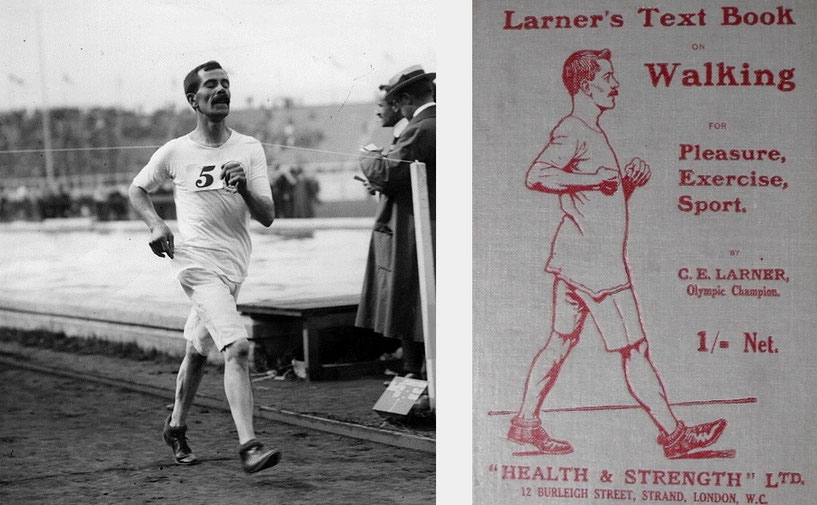
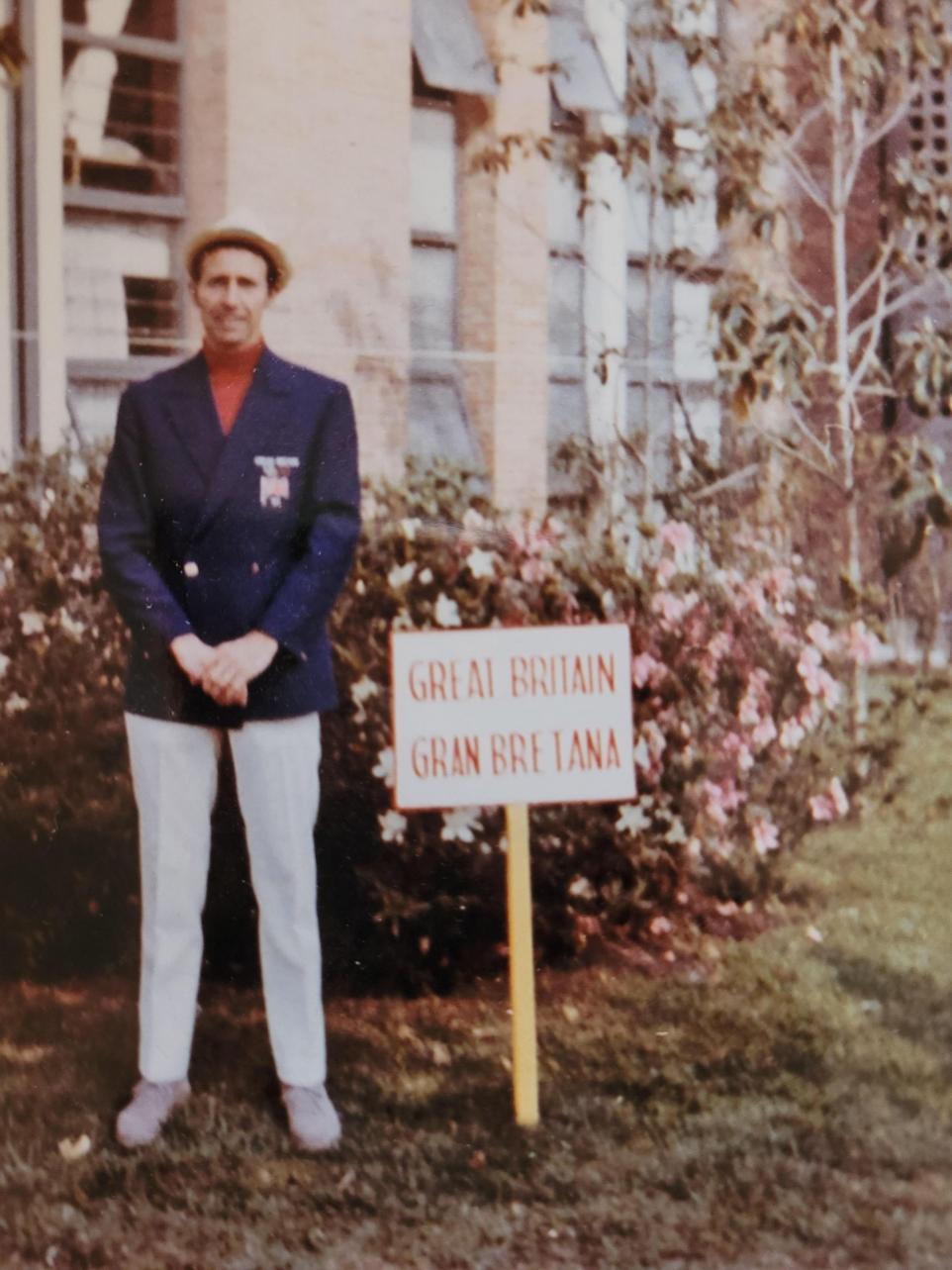
Within the bio, Tim draws our attention to a lovely piece by Alan Buchanan, which first appeared in the Race Walking Record, of which Alan was an outstanding editor. This version appeared in Sussex Athletics under the title.’ THE ONLY SUSSEX DOUBLE OLYMPIC GOLD MEDALIST’.
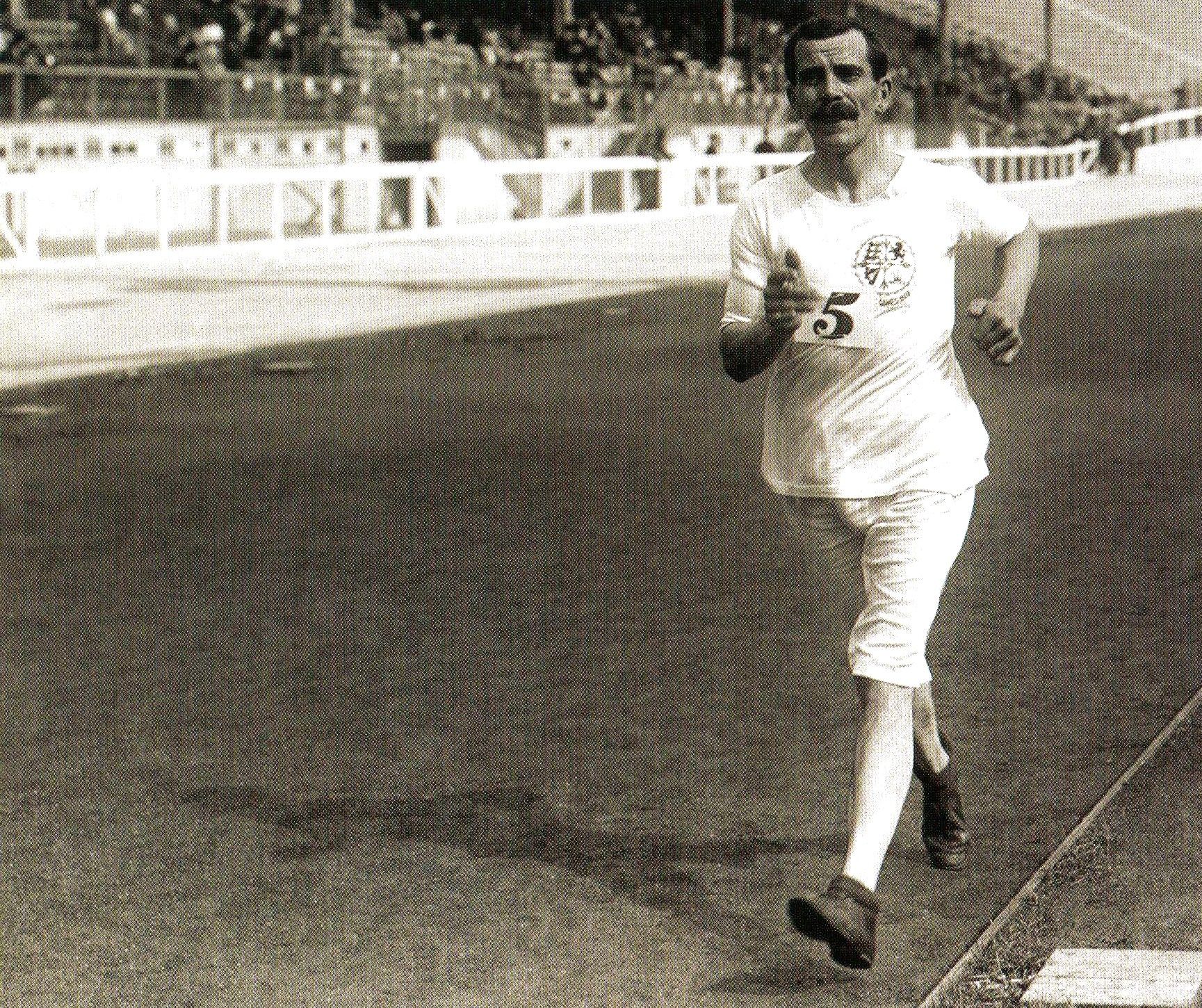
At the 1908 London Olympics, George Larner of Brighton and County Harriers won the 3,500m Walk and the 10 miles Walk. Those distances were never raced again, so to this day Sussex has a club athlete who holds the two Olympic gold medals and the Olympic records.
I switched from running to race walking in 1966, encouraged by Arthur Jones, who two years later was selected for the 20km at the Mexico City Olympics, along with Brighton and Hove AC club mates Chris Carter (800m) and Andy Todd (4 x 400m relay). I worked for the Brighton and Hove Herald through the sixties and researched their archives at the time to write an article on George Larner for the Race Walking Record.
Although born in Berkshire in 1875, he took up walking with the club in 1903, aged 28 and soon showed an aptitude for the event, winning four AAA titles in the following couple of years, including nine world records. He was a Brighton Police Constable and soon found that his duties prevented him from serious walk training. The Chief Constable was made aware of this and in 1906 the County Borough of Brighton Watch Committee gave Larner special dispensation, to train for the London Olympic Games, which were to be held in 1908.
He ends on an unexpected note:
Few sportspersons can expect to have the honour of their name emblazoned on their local bus. When George Larner was born in 1875, there was no such thing as a motor car as we know it, let alone a double-deckerbus. He, however, is celebrated on one of the Brighton & Hove buses, and is one of the only sportspersons and is the only athlete who rubs shoulders, metaphorically, with the great and good associated with the City.
Following the unfortunate cancellation of the Dick Maxwell trophy race on December 3rd, it has been agreed that we organise a December Virtual 5 kilometres in addition to that envisaged for January. Both will count in the overall Club Handicap competition. Your December clockings should be sent to me at tonymtaylor@gmail.com by January 2nd at the latest. Weather allowing, this gives members three weeks to fit in a 5 kilometres blast, which should stand us in good stead for the longer challenges ahead. I’ll submit these to Dave Evans for the handicap adjustments and put up the result post-haste. Accompanying photos will be gratefully received.
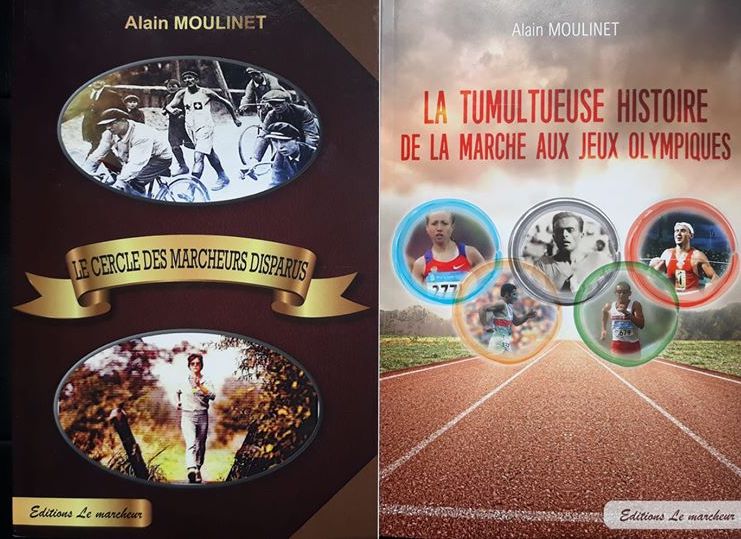
Given our club’s proud history in the longer distances, I thought you might enjoy this brief extract from one of Alain Moulinet’s two books on ‘Le Longue Marche’
The Missed Appointments of Two Athletics Giants at the Olympics
Donato PAVESI and Florimond CORNET
After the unchallenged domination of British pedestrians at the beginning of the 20th century, the Azzura team established its world supremacy in the discipline, thanks to the many popular events organised at that time. It is particularly one of them, that one hundred years ago, on November 19, 1922, between Brescia and Milan, the ‘campionissimo’ Donato PAVESI (first walker under 10 hours on November 6, 1914, in 9:59:48) smashed his own World Best Performance in the 100km walk, clocking 9:51:37. Donato PAVESI unquestionably became, at the start of the 1920s, the world No. 1 in all the great international classics, such as London-Brighton (85km) and Manchester to Blackpool (83km), which allowed athletic walking to compete with cycling. into the hearts of the public and draw huge crowds to the roadside.
Also excellent over short distances, Donato PAVESI was, unfortunately, the victim during his two participations in the Olympic Games of the still very uncertain judgment of this discipline. In 1920 in Antwerp, in the 3000m, while fighting for second place in the home stretch, he was disqualified. On the second walking event of these Games, the 10000m, he was destabilized and slowed down by the incessant remarks of the judges. Having managed despite everything to finish 6th, he learns, as soon as he crosses the finish line, his disqualification! At the 1924 Paris Games, this Olympic curse pursued him: he narrowly failed for the bronze medal by finishing 4th. However, he ended his brilliant sporting career on the Milan track with a World Record for the 20,000m walk in 1h37’42”.
As athletic and slender as Donato PAVESI, the prodigy of French walking in the 1930s, Florimond CORNET, in turn, pulverized the Best World Performance of the 100km in 9h41’57’’, on May 9, 1937, in Montargis. Two weeks later, on May 22 and 23, 1937 on the selective East circuit in Paris-Strasbourg, he appropriated two other World Best Performances over the 200km in 21h58 ‘and the 24h with 216km460 to his credit. The following year, on July 10, 1938, in a 170km event (!!!) around Lake Geneva, which he won, he improved his 100km record in 9h39’05”. Then again, the following year, on June 25, 1939, on the occasion of the Bol D’or de Paris organized at the Aubervilliers stadium, he confirmed these extraordinary road times by setting the first World Record for the 100,000m track in 9:41:39. That year, he achieved a unique feat in the annals of walking: being crowned French Champion of the 50km twice in the two competing federations of the time, the U.F.M. and the F.F.A.
Indeed, in view of the brilliant results of the walkers of the French Walking Union one year before the Olympic Games scheduled for Helsinki, the French Athletics Federation proposed a merger agreement and temporarily accepted the joint participation of the walkers of these two sports entities at their respective championships. So much so that Florimond CORNET easily won the UFM 50km championship on May 8, 1939, in Metz, in 4h28’46” (Best French Performance) then, on July 23, less than a month later after his 100,000m track exploit, he doubled the lead by outclassing the FFA 50km championship in Colombes, in 4h35’03”. Unfortunately, the noise of boots at the end of the summer of 1939, ruined the Olympic hopes of the prodigy. Florimond CORNET. He was only 28 years old, the golden age for a walker……….
Dave Evans writes to alert us to the fast-approaching Dick Maxwell Memorial and Xmas 10-kilometres race to be held on Saturday, December 3rd at Simister, starting at 1.00 p.m.
Back in 2021 and back into the warmth!
We will be using our usual 10k course, out and back (twice)into Heaton Park. As the weather can be a factor we have moved away from the original ‘nightmare’ course and will now just race on the regular 10km course from our headquarters. Dave would appreciate it if all club members could confirm their availability by email at dave.evans08@hotmail.co.uk, indicating if they are walking or would be available to help with marshalling and any other tasks.
Not to be pessimistic but take account of Pat’s apparel!
LANCASHIRE WALKING CLUB 2023 RACING FIXTURES
Date
A/B
Distance
Event
Time
Venue
Jan 1st-31st
B
5k
Virtual 5k
Feb 4th
B
10k
Sam Shoebottom Trophy
13:00
Simister
Mar 4th
B
15k
Alison Trophy
13:00
Chorley
Apr 1st
B
10 miles
Macclesfield Shield
13:00
Macclesfield
Apr 15th
Grand National
Apr 23rd
Blackpool Marathon
May 6th
B
7 miles
Dave Crompton Memorial Trophy
13:00
Chorley
June 3rd
FA Cup Final
June 10th
B
10k&5k
Track Walk R&Z Smith Trophy
13:00
Bury AC Track
June 18th
5k
Possible Horwich event
Horwich
July 1st
B
10k
Barnard Trophy
13:00
Macclesfield
July 22nd
B
3x5k
Fred Pearce Trophy Relay
13:00
Simister
Aug 12th
B
10k
Goodwin Cup
13:00
Chorley
???
B
100 mile
Possible Centurion 100 mile
?
MiddlesbroughSports Village Cycle Circuit or Colchester
Now and again I worry that my reminiscences are often rooted in the 60s and 70s but hope that they are still worthy of mention. Thus it falls to me to report the death of John Webb, universally recognised as one of the great stylists of his generation. Ironically, at our AGM, Glyn Jones and I were reflecting on the disappearance of the notion of ‘style’ from the race-walking lexicon. Back then many races would include a style prize and indeed the AAA 7 miles/10,000 metres track championship featured the coveted Fowler- Dixon style prize. I remember Paul Nihill being over the moon at receiving this honour, especially as his style differed from such greats as Matthews and Vickers. I should check this but I’m sure our own Ron Wallwork was also awarded this honour.
On a personal level, my dearest memory of John is him congratulating me generously at the end of a race-long tussle in the 1970 National 10 miles championship held in Kirkby. I managed to hold him off to finish sixth in 74:07 to his 74:19. Ahead of us, Ron was second to Wilf Wesch, clocking 72:13.
I heard first of his passing on the Portuguese website, O Marchador.
The British Olympic marcher John Albert Webb passed away last November 9, a victim of a prolonged illness, he counted 85 years old.
Webb, born in Dagenham, England, moved as an adult to Essex, an eastern county, where he represented Basildon Athletics Club. He was the first athlete from this club to participate in an Olympic Games, 1968 in Mexico, in the exciting 20 km walk won by the Soviet / Ukrainian Vladimir Golubnichiy, a test in which he was ranked twenty-second out of 34 competitors.
Among the eight international appearances by Great Britain of this inspiring athlete in the period between 1966 and 1972, the participation in the European Athletics Championships, in Budapest-1966 (13th, 20 km) and in Athens,1969 (8th, 20 km), and also at the Walking World Cup in Bad Saarow (Germany), in 1967 (8th, 20 km).
The “O Marchador” team sends heartfelt condolences to family, friends and the British racewalking community.
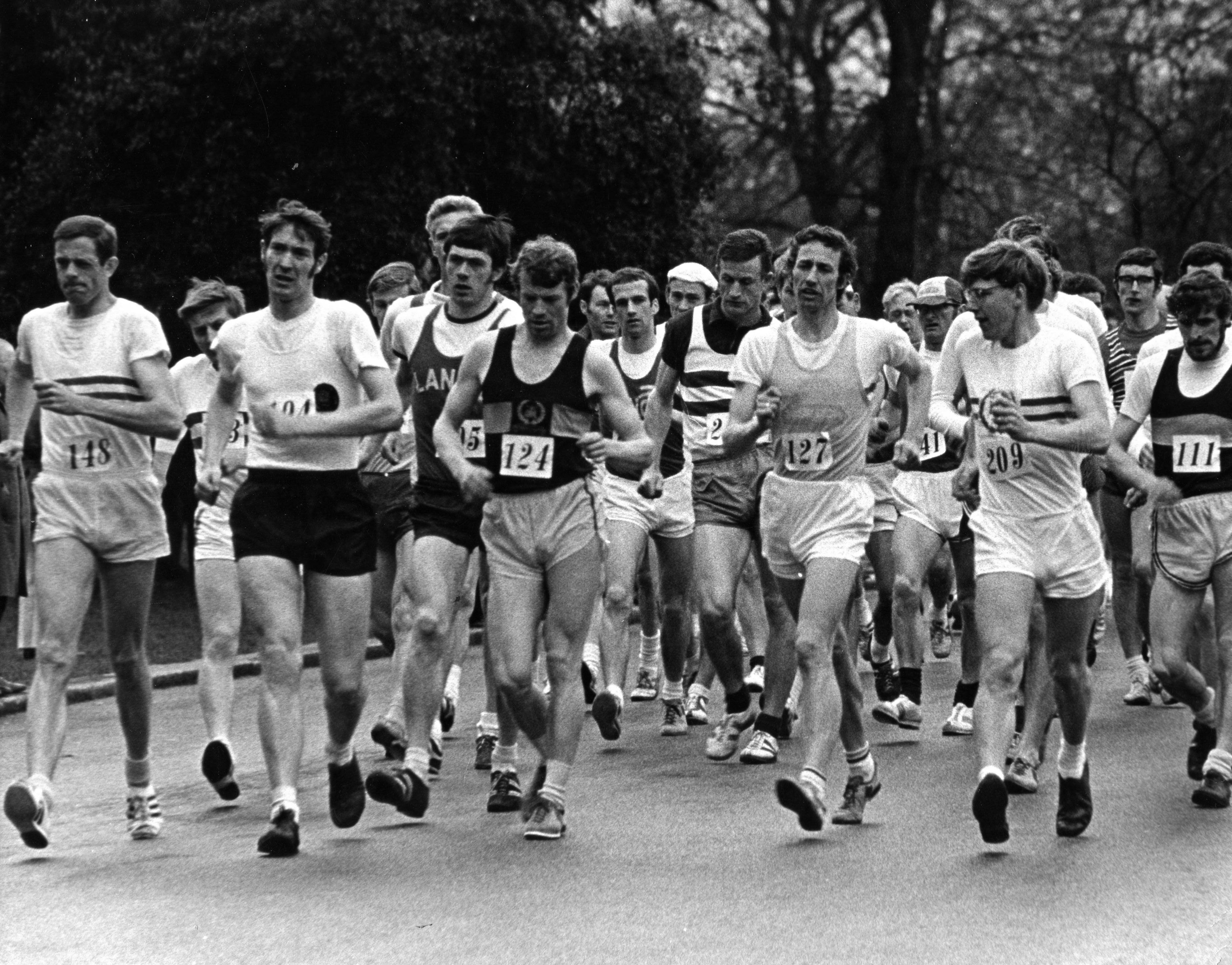
In this atmospheric photo of the start of the 1970 Metropolitan 20 kilometres. John is number 127
Whilst the Basildon Echo under the banner headline, Tributes pour in for legendary south Essex Olympian who passed away aged 85, featured a number of tributes.
Bob Hughes, who competed with John in the high-altitude cauldron of Mexico in 1968 commented, “He was one of the best guys you could wish to meet, Johnny Webb came to my wedding along with one or two other notable walkers, way back in November 1969. I had a few battles with and also suffered in a few races with him, but we always went back for more, sometimes taking turns to be the victors.
Paul Warburton, a former member of Southend-on-Sea Athletic Club, recalled how he was inspired to take up race walking by Mr Webb. “ He was the first racewalker I saw in the flesh. He used to train past the house each night. His passing is so very sad.“
Sandra Brown, 73, a former international race walker who holds several world records, said: “John lived near the Bristol to Bath old railway path and said that he did all his training up and down that excellent recreational route.
1973 National 10 Miles
Roger himself comments:
Lovely man, Essex boy and loyal club man in the true sense. Competed 100% in races, ultra fair, lovely technique and great company. He turned me over more than once! RIP JW
And Greg Smith, our very own club secretary remembers fondly:
John Webb got me into race walking around the same time as Oliver Caviglioli and, like him, I have many warm memories of those days. From the mid-1960s to the early 1970s, the peak of John’s success as an athlete, race walking flourished at Basildon AC. Basildon walkers enjoyed great success at both age group and senior levels.
John was at the centre of that development, driving it on with his enormous enthusiasm and energy. He was an inspirational figure. John was keen to encourage others to share his passion for race walking, athletics and the outdoor, active life. John was a sparky, good-humoured character: talking with him, you never quite knew where the conversation would go next. He had a generous outlook and a strong sense of fairness.
The Sunday morning group training sessions with John from Phil Everard’s bungalow in Crays Hill stand out in my memory. We timed our sessions by the garage clock at the top of the hill and afterwards drank tea in the Everards’ kitchen. The talk could range from training niggles and what was in this week’s Athletics Weekly to the bigger issues of the day. As John’s son Harry reminded us in his eulogy at the funeral last week, John was a man of firm principles. When invited to compete for Britain in apartheid-era South Africa, John very publicly refused.
I learned a lot from John, not just about race walking. For me, he lit a fire that still burns. He will be missed but not forgotten.
I’ll leave the last word to Oliver Caviglioli, who in the late 60s was well-known and admired in Lancashire circles, not least for the fluency of his action. His great rival in the Youth ranks was our very own Steve Crow. In 1967 Olly. as he was known, won the National Youth 3 miles championship at Worsley in 23:01 with Steve second in 23:35. Both passed through 1 mile in 7:10 before Olly pulled away.
John Webb was my hero. And remained so. As a 13-year-old, I was awestruck by the upright, athletic-looking man in a GB tracksuit. He was friendly and soon invited you into the world of international athletics, introducing the leading contenders here and in Europe. He named his dog, Abdon (Pamich). As you might guess from this, he was playful. During our runs in the woods, he used to play a game of submission. If I accepted a branch he offered me, I was defeated. To decline it would result in another 5 minutes of searing pace.
His technique was superb. When, later, I had the opportunity to witness the leading race walkers from Europe, I still thought none matched John’s upright, athletic and always safe mode of progression. His running style, by contrast, was a rangy, bouncy affair. On occasions he mixed both in a training session, switching from road walking to cross-country running — and all with no notice of the changes, as I struggled to keep up and understand quite what was happening.
He was his own man, starting his day at 6:00 am with 30 minutes of reading his beloved Charles Dickens before setting off to run to work at the centre for adults with learning difficulties. Years later when I learned that my firstborn had Down syndrome, John was one of the first people I telephoned. His was the perfect, yet totally unexpected, reply: “some of my best friends have Downs Syndrome!” I feel honoured to have known John, and during my daily walks through the self-same woods we used to run through, I think of him every time.
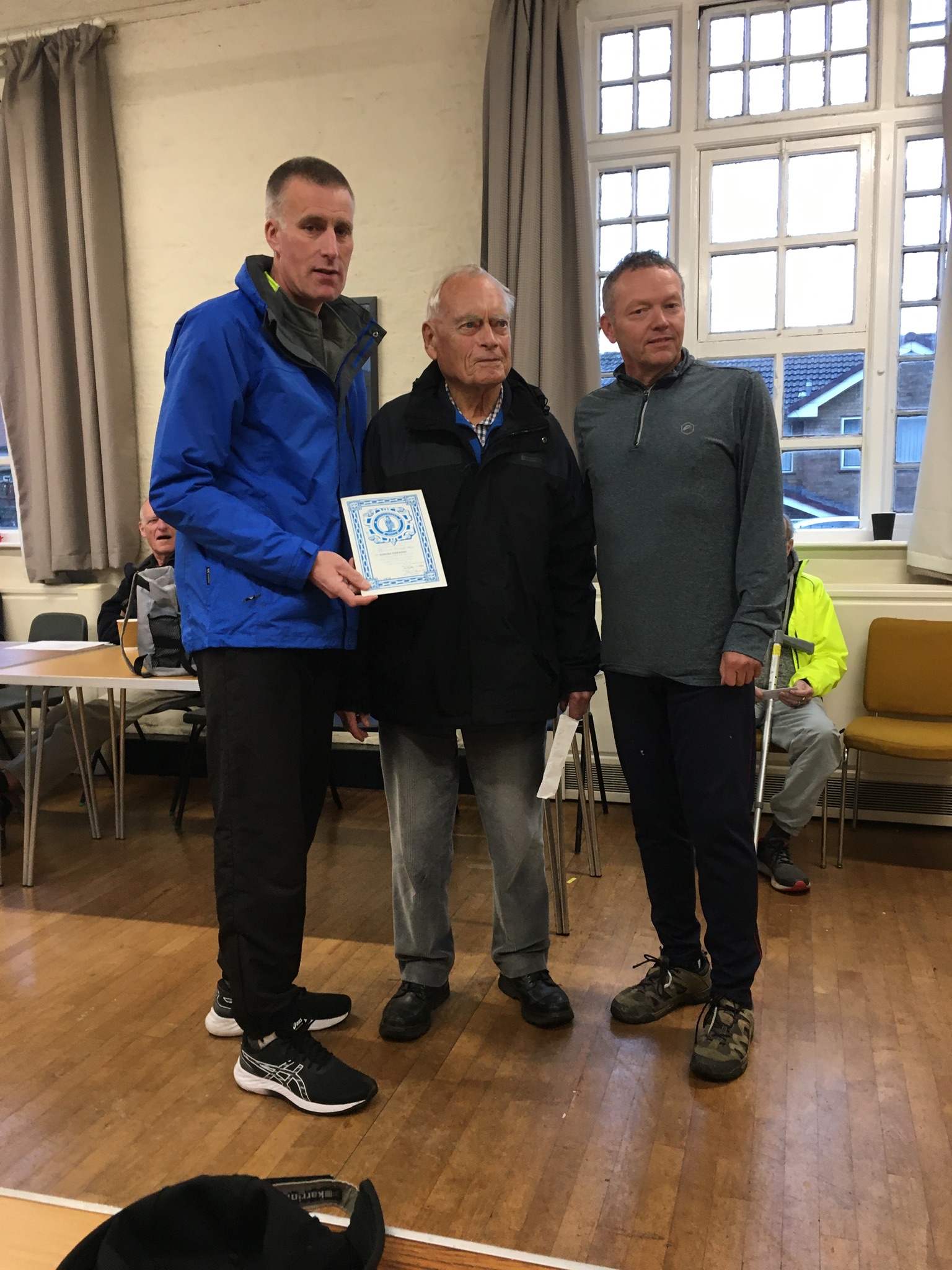
Chaired impeccably by Dave Evans, minutes taken diligently by Tony Bell, our Annual General Meeting was dominated by one figure. Unsurprisingly this was the always unassuming Adrian Edwards, whose courageous feat in becoming a Centurion was hailed by Eric Horwill as one of the gutsiest he had ever witnessed. And Eric has competed in and officiated at more long-distance events than probably anyone else in the country. His praise means a lot. Marking this remarkable achievement Adrian collected both the Cliff Royle and AJ Taylor trophies. In addition, he was presented with the priceless Centurions’ certificate. of membership by Eric and Martin Fisher, the present Centurions’ President. Everyone was unanimous in their respect for Adrian’s endeavour. Believe it or not, word has it that he has his sights set on further long-distance challenges. To round matters off Adrian was elected to be the Club’s President for 2022/2023.
Adrian, Eric and Martin
In a much-appreciated gesture Sailash Shah on behalf of himself, Adrian and Martin Payne, our trio of competitors at Middlesborough, presented Dave and Pat Evans, alongside Roy Gunnett with bottles of wine in tribute to their unstinting support across a wind-swept and rain-battered 24 hours. The nectar in question was ‘Chateau de Neuf Pape’, described as having ‘a spiced black fruit aroma and a velvety warm palate’. One detects Sailash’s knowledgeable hand in this elegant choice. Bravo!
Elsewhere in the meeting, Dave spoke to his Chairperson’s report, offering his condolences to John Payn for the loss of his dear wife, Flo and to Martin Fisher on the passing of his redoubtable father, whilst Joe Hardy was thanked for his sojourn as President and Roy Gunnett calmed our nerves with his Treasurer’s update. Our books are balanced but the demands of subscriptions to English Athletics and the Northern Area means an increase in our annual subscription to 20 pounds – still a snip.
Wonderful to see John Payn, Judith Fisher and Christine Pearce, sitting between Eric and Pat
Tony Malone, backed by Chris Harvey, launched an interesting discussion around the case for a Sunday morning race as one of our club fixtures. In the end, it was agreed that we should consider such an inclusion in 2023/2024, possibly using Woodbank Park as a venue. Flowing out of this debate we touched upon whether nurturing a closer relationship with an athletics club, for example, Stockport Harriers would be to our benefit, increasing our visibility and hopefully attracting new blood.
Thanking folk for their generous comments regarding the club website, I revealed that I wanted to revive the series, wherein individuals shared their memories of how they got into race walking, their favourite races and their best performances. I will be getting in touch with members in the coming months to see if they are happy to be involved.
On a personal and indulgent note, I informed the meeting that the coming year would be my 70th since my first race as a six-year-old in 1953. Thus, all being well, I intend, at the very least, to be on the starting line at the Fred Pearce Relay in July and hope that there will be faces. past and present, in attendance. Watch this space.
Both Martins, Steven, Phil and company anxiously await Dave’s announcement of the course for the Xmas Handicap!
As the meeting closed Dave informed the gathering that the Dick Maxwell Xmas 10km race will not be held on the notorious ‘Nightmare’ course. The collective sense of relief was palpable.
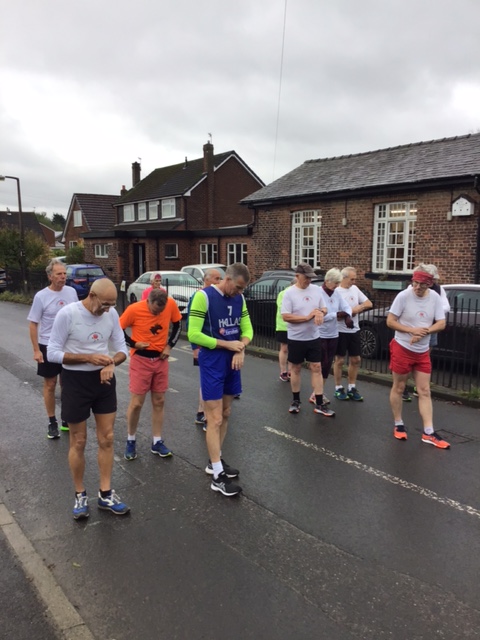
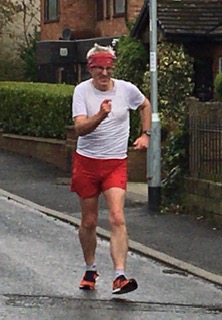
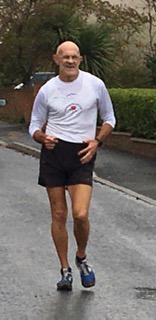
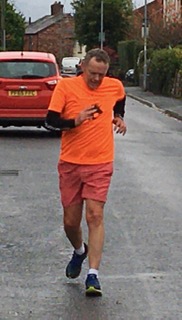
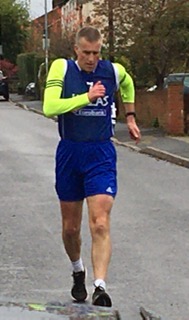
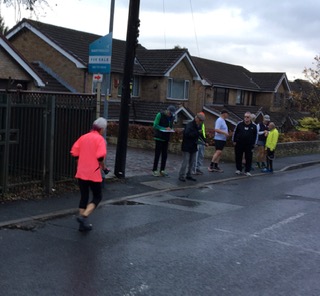
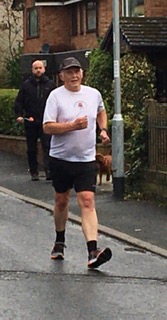
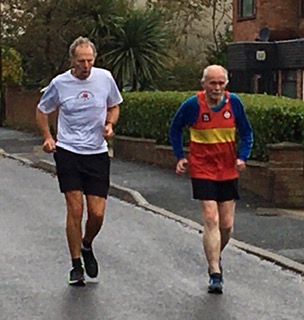
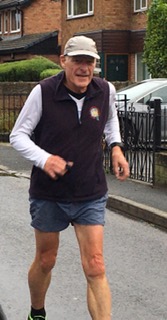
Three years on it was great to be back on the road again with everyone. In the photo below taken by Dave Evans, it looks as if I know what I’m doing with my watch but I pressed all the wrong buttons. As for the weather, I must confess to being mard and finding it a touch cold!!
On your marks
Dave Evans reports:
Tony Bell sprints away
No fireworks on this occasion but some healthy competition from a baker’s dozen on the usual “out and back” course. Tony Taylor, our former international, was visiting the UK from Crete and certainly put the cat amongst the pigeons as despite some ongoing muscle problems he made his way to the head of the field at halfway.
Tony Taylor chases in vain
Martin Fisher and Adrian Edwards normally vie for honours in this event but as the 13-strong ensemble turned for home it was the bandanaed Tony Bell who charged to the front with Tony Taylor in close attendance. Given that Tony is carrying an injury at present he did well to match strides with his much younger opponent but the final half a mile or so became a bit problematic as a long steepish section met them towards the end.
Metronomic Martin
Martin Fisher walked with his usual metronomic style and was rewarded with a sub 30-minute time only 17 seconds adrift of the second place.
Centurion Adrian
Adrian Edwards is still recovering from his Centurions 100 mile so his time was a bit behind his normal clocking.
Andrea’s performance of the day
One of the best walks of the day was by Andrea Lennon, a very sprightly octogenarian, who has recently completed the Manchester half marathon. Her 40 mins 57 was tremendous and one of her best times ever over the distance.
Roy ‘Heel and Toe’ Gunnett
Steven and Glyn keep close company
RESULTS – SCRATCH
Tony Bell 29:19
Tony Taylor 29:24
Martin Fisher 29:41
Adrian Edwards 30:42
Roy Gunnett 33:46
Glyn Jones 33:59
Steven Wilde 33:59
Ian Hilditch 35:02
Sailash Shah 36:13
Pat Evans 36:19
Phil McCullagh 37:47
Joe Hardy 38:22
Andrea Lennon 40:57
Ian’s stylish gilet
Sailash holds off Pat
HANDICAP
Tony Bell 25:59
Roy Gunnett 26:16
Glyn Jones 27:09
Martin Fisher 27:41
Steven Wilde 27:44
Adrian Edwards 28:12
Andrew Lennon 28:27
Sailash Shah 28:58
Tony Taylor 29:24
Pat Evans 29:24
Ian Hilditch 30:32
Phil McCullagh 30:37
Joe Hardy 32:02
‘Day-glo[ Phill
Our retiring President, Joe
Thanks to Martin Payne, sidelined by a hamstring injury, for the photos.
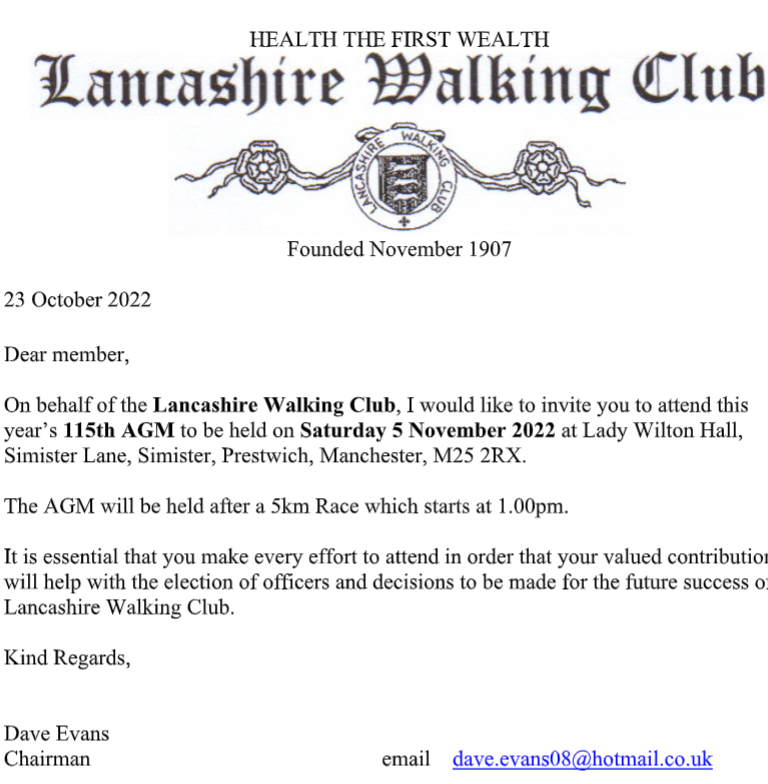
You will find below the invitation to the 116th AGM of our great club, together with the Chairman’s and President’s reports. All other papers pertaining to the AGM have been circulated by Greg Smith, who unfortunately is unable to be with us – sincere thanks to him for his labours. Please send your apologies if you are unable to attend and in the same vein let Dave know if you will be at the race and in what capacity. It helps preparations enormously. It’s important to stress that the AGM is the moment when members renew their annual subscription, which this year stands at twenty pounds. This is a veritable bargain especially as seventeen of these pounds go to England Athletics and the Northern Counties with a mere three going into club funds. All being well I will be at my first AGM since 2019 and look forward to being with everybody in person.
Tony Taylor [ A Lancastrian abroad]
Chairman’s Report November 2022
I am pleased to begin my report by saying that the major issues presented by the Pandemic have largely disappeared so our calendar of events has continued as planned. Two fixtures had to be cancelled through the illness of one venue host and the refurbishment of the Bury track but in the latter case, an alternative venue was found.
Although we are all one year older, it is very pleasing to see that we have generally held together as a group and while times are a little slower, the enthusiasm is still there. At this point, I should add that our youth programme has come to nowt but we have acquired a new member who is improving well and making his presence felt. Steve Wilde is a runner by background and is getting the hang of things in this technical discipline.
Our regular venues continue to be available thanks to the good work of Roy Gunnett. The charges for race venues have remained fairly static and thanks must be given to Eric Crompton for providing an alternative changing area when the St Peters Club was closed.
From a competitive point of view, our race numbers have been encouraging with between 7 and 13 walkers. In the latter part of this year, a couple of our regulars have been side-lined through injury but both have hopes of returning to the fold in the near future.
Few, if any, walking clubs in England, promote monthly club events so we should be proud that we are continuing a tradition established way back in 1907 by our founders.
Most organisations rely on a number of backroom staff and I would like to take this opportunity of giving my thanks to Roy Gunnett, Tony Taylor, Greg Smith, Adrian Edwards, Eric Crompton, Louise Whaite, Pat Evans, Marshall Barnard, Chris Pearce and Ian Hilditch, all of whom have provided logistical support throughout the year. A special mention must be made of Eric Horwill who travels from the Midlands to the vast majority of events to do our timekeeping and Glyn Jones, a fellow Midlander, who has been a regular competitor and a confidant on all matters relating to the sport.
I am sure that colleagues will mention this as well but the highlight of the club’s performances this year has to be in the Centurions 100 mile in Middlesbrough. The bravery and character shown by our representatives were outstanding and we were proud of all of them.
Adrian Edwards became the Club’s newest and 41st centurion, Martin Payne almost walked that magical distance again, Sailash Shah was battered by the wind and rain into submission and Martin Fisher had to cut short his attempt to claim his 29th hundred.
We move into our 116th year with the knowledge that we are continuing to promote our sport and are mindful of the club’s antecedents who laid the foundations of the Lancashire Walking club. Long may we continue.
Dave Evans, Chairman, Lancashire Walking Club, November 2022
President’s Report 2021/22
In the last 12 months, the Lancashire Walking Club has continued to pursue an activity which is now in its 115th year. As Club President I have been very pleased to share the camaraderie and enthusiasm with my fellow walkers and long may it continue.
We are steeped in tradition and still celebrate the achievements of former club members as far back as 1924 when Reg Goodwin took a silver medal in the walk at the 1924 Olympic Games. Most of our club trophies are named after individuals who brought credit to the club and rightly so.
This last season, 2021/22, saw us returning to something like our old timetable at venues in Simister, Bury, Chorley and Macclesfield, all of which have been supported by our regular nucleus in good numbers.
In previous years one notable highlight would have been the British Masters’ championships at Horwich where we collected almost as many medals as we had participants. However, these championships were sadly cancelled when the host town was unable to provide the usual facilities.
Aside from this event, we had no major championships on the calendar, however, hopes were high that we might be fielding a number of individuals in the 2022 Centurions 100-mile race at Middlesbrough.
In August, four of our club members toed the starting line for the country’s longest race-walking challenge in the hope that we could add more names to the Lancashire Walking Club roll of honour, numbering 40 at that point.
Twenty-four hours after the start the Centurions were delighted to receive Adrian Edwards into the Brotherhood after his highly traumatic journey around the 166 circuits of the Middlesbrough cycle track. His journey has already been described on our club website but suffice to say his success was hard-earned and richly deserved.
Martin Payne, already a Centurion, completed the sojourn around the open enclave, failing narrowly to double his tally for the event, as he too suffered trauma on route but regained his composure in the last two hours.
Sailash Shah was walking very well in the first 6 hours but 40-mile-an-hour winds and torrential rain closed in as it was going dark and he was unable to sustain the pace required to make the 100-mile cut-off. He lives to fight another day and he will.
Martin Fisher, our second claim member, succumbed to an underlying health problem and was to step off the circuit at halfway. With 28 previous 100’s to his name, he has nothing to prove.
Former club member, Hazel Fairhurst, completed her second Centurions event with a tremendous display of disciplined walking knocking around an hour off her personal best.
As President, I have been privileged to see the Club continuing to promote its events and aspiring to keep the Club’s name in the headlines. While we owe a vote of thanks to our committee members and helpers on this side of the European continent, may I give a very big thank you to Tony Taylor, our website controller, for his magnificent contribution to the life of the Club. One of these days he may make it over from Crete so we can thank him personally.
Joe Hardy, President, Lancashire Walking Club, 2021/22
Back at the end of 2021, Tim Erickson posted the following thoughts in the Victorian Race Walking Club Newsletter about the three books on Race Walking published by the governing bodies in the UK since the Second World War. I asked him if I could pinch his musings and in particular the pdf link to the second of these books, which he favoured. He readily agreed. Being slow at times [increasingly so!] it has taken me this long. As you will see I was particularly delighted that he was most impressed by the manual written by my dear friend and training partner Julian Hopkins, who joined Lancashire Walking Club back in 1961. Published in 1976 it is still well worth perusing its contents.
The cover features the ever-stylish Roger Mills, the 1974 European 20km bronze medallist
Julian is on the extreme left along with Eric Crompton, Mick Entwistle, Fred Pearce, Ron Wallwork and myself at the 2016 celebration of Ron’s 2 Hour record.
In the report on the 2016 event at Bury, I supplied some comments on those of us, who raced on that rainy day in 1971. In Julian’s case, I noted.
Julian Hopkins, is famously or infamously, remembered as a National Coach way ahead of his time, hounded out of the sport for observing that contact was increasingly impossible as the event developed. In his time he was featured on the cover of Race Walking Record, in July 1967, as a rising star, having finished 10th counter in the National 20k, won by Ron Wallwork, enabling a second place for the club. In 1970 he was integral to the team that placed first, second and third in the four senior championships, alongside Wallwork and Taylor, ensuring that the club won the A.D. McSweeney trophy as the leading club of the year, ahead of 29 teams – with four walkers to count in all championships. The other counters in that notable year were Dave Vickers [10 miles], Chris Eyre [20k[, Don Warren [20 miles] and Mick Entwistle [50k].
There is no doubt that an interview with Julian is called for. I will do my best.
Roy Gunnett reports, whilst Greg Smith and Irene Pike provide an array of great photos, many be saved in the Images archive.
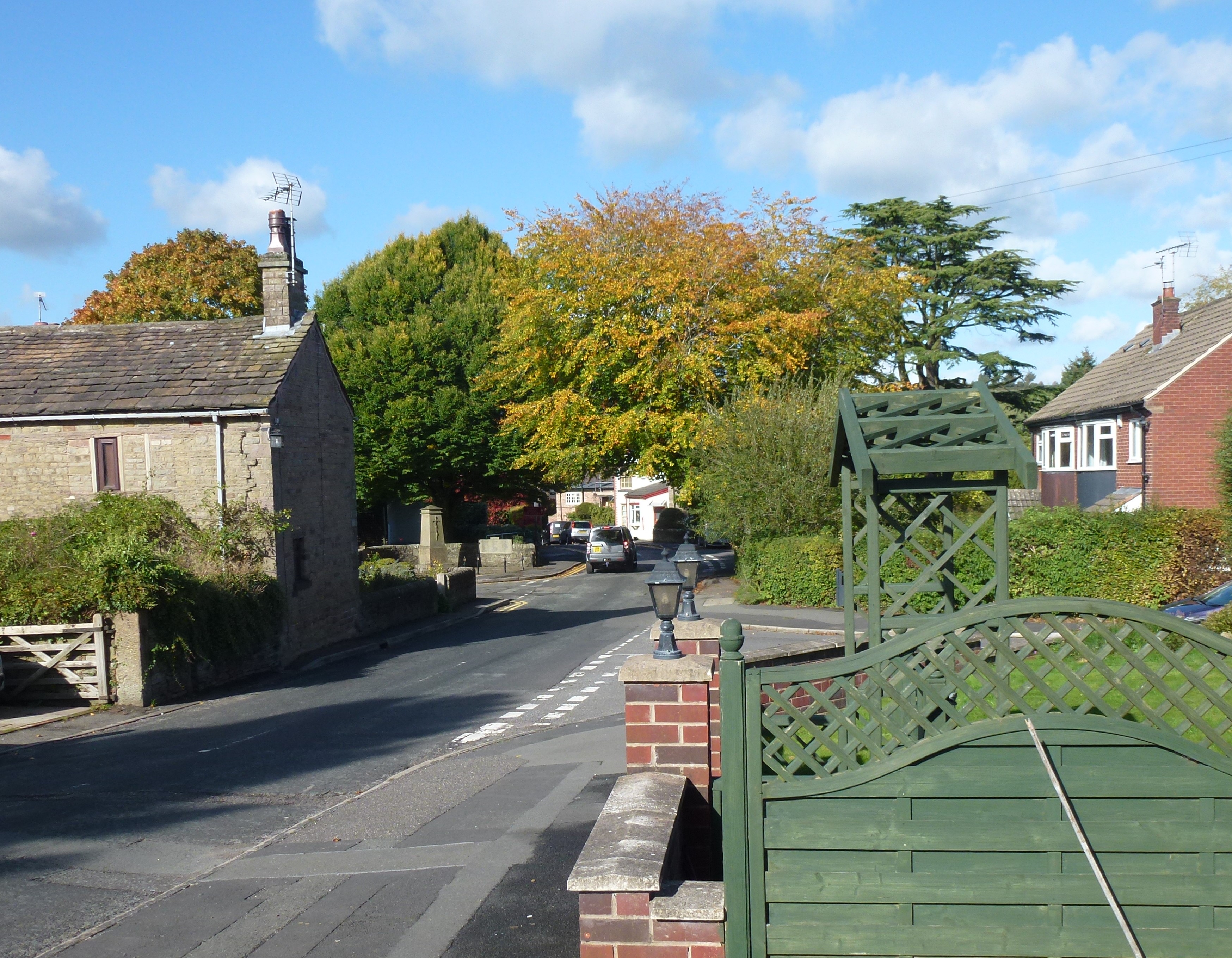
Picturesque Sutton – the scene of many race walks across the years. Ta to Greg
Albert Rigby Shield 10k @ Macclesfield 8th October 2022
A field of 7 walkers took part in the Albert Rigby Trophy 10k race at Macclesfield.
Most of the field in the picture. Ta to Irene.
A number of the walkers and officials only just arrived in time for the race – due to very heavy local traffic. The normal 3-lap ‘out and back’ hilly course was used. On this occasion, there were no guest walkers. Just before the race rain clouds threatened – luckily, however, these soon blew away and the walk took place in mild conditions with sunny spells.
Greg, Roy and Steve in close formation with Sailash hidden. Ta to Irene.
Joe Hardy somewhat isolated. Ta to IreneA determined Sailash also unaccompanied. Ta to Irene
The walkers were split into 2 groups – Adrian Edwards and Martin Payne being in the fast group and the remainder in the other. Adrian and Martin were started 3 minutes behind the others. This was Adrian’s first race since his heroic walk at Middlesbrough when he succeeded in becoming a Centurion in late August.
Adrian Edwards leads Martin Payne. Ta to Greg
Adrian and Martin walked together for most of the race, with Adrian just pipping Martin at the end to win the scratch race. Both walked extremely well in the aftermath of their epic centurion race only a few weeks earlier.
Locked in combat Adrian holds off Martin. Ta to Greg
The race for third place was contested by Steven Wilde and Roy Gunnett in a final dash for the line – this resulted in a draw between them.
Steve and Roy on their way to a dead heat! Ta to Irene
Huge thanks must go to Eric Horwill, Glyn Jones, Ian Hilditch, Irene Pike and Chris Pearce for their help in Timekeeping, Marshalling etc.
Ian Hilditch on marshalling duties aided by a local road sign. Ta to Irene
As usual, Marshall and Kath Barnard were wonderful hosts. They put on a magnificent spread of food/ tea and they provided and awarded prizes to the first 3 in the handicap.
Martin Payne won the Albert Rigby Shield for being the first Lancashire walker in the handicap and he was presented with the shield by Marshall. Marshall’s wife Kath is the niece of Albert Rigby – whom the Shield is named after.
Scratch Race
1 Adrian Edwards. 63.36
2 Martin Payne 63.37
3 Stephen Wilde. 71.39
3 Roy Gunnett. 71.39
5.Sailash Shah. 73.49
6 Joe Hardy. 78.59
Greg Smith 2 Laps 6.7km 49.36
Handicap Race
1 Martin Payne. 58.37
2 Roy Gunnett. 60.09
3 Stephen Wilde. 60.39
4 Sailash Shah. 61.49
5 Adrian Edwards. 62.16
6 Joe Hardy. 65.39
Another landmark feature to be found on all the differing courses over the years. Ta to Greg.
Sadly today’s Chorley Six Hour Challenge had to be postponed because of one of the key organisers’ serious illness. We wish her a speedy recovery. As it is our next club event, the Albert Rigby 10 kilometres, will take place next Saturday, October 8th from our much-loved venue in the village of Sutton Macclesfield, starting at 1.00 p.m. As ever it would be helpful both to Dave Evans and Marshall Bernard if you could let Dave know of your intended attendance.
A beautiful but testing course
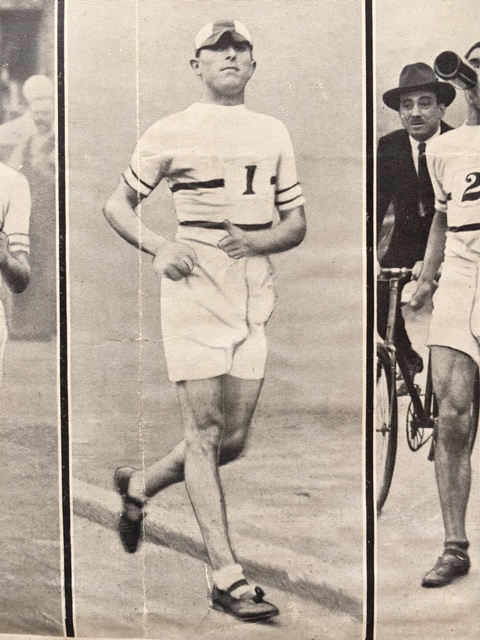
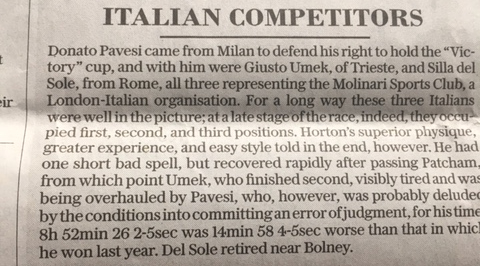
Meanwhile, we are grateful to Guy Goodair for unearthing this fascinating newspaper article from exactly a century ago – September 1922. Doesn’t time pass us by?