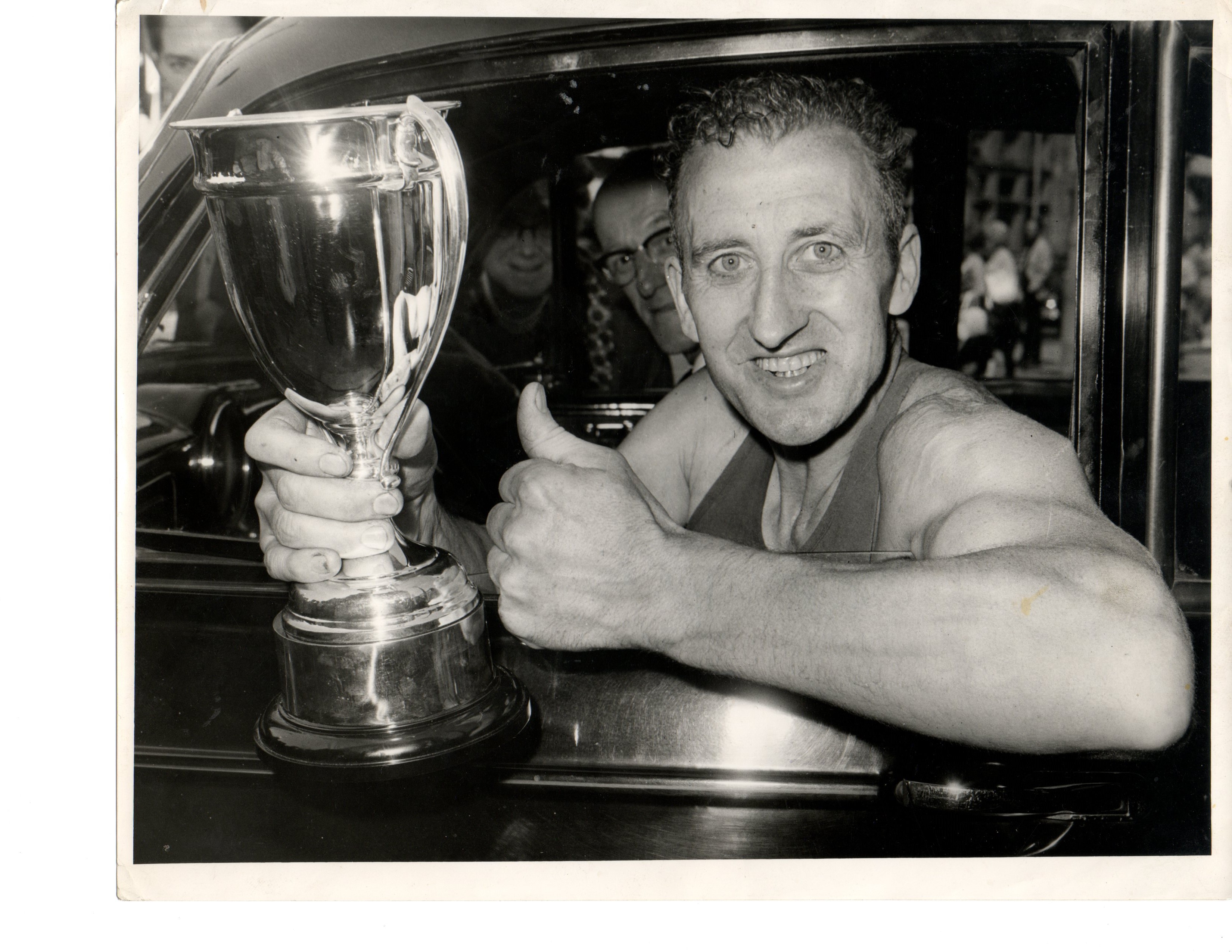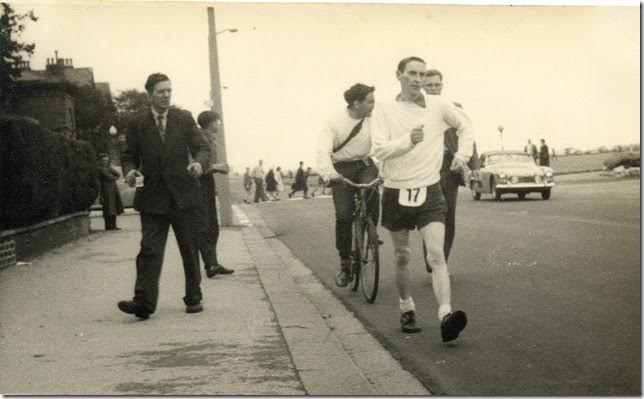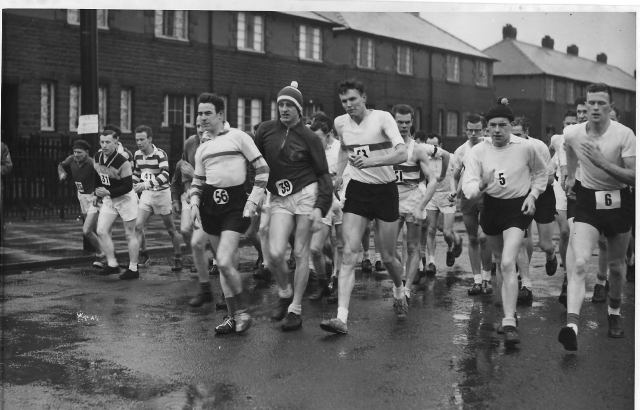
Putting our Best Foot Forward : Tom Payne shows the way

Firstly I must apologise that the site has been dormant for well over year. I’ll spare you the excuses, but it’s not entirely down to my dull sloth. Whatever, my New Year resolution is to get things up and walking again. In doing so I’m proposing that the site changes its character somewhat. Without abandoning its commitment to reflecting the history of our great club the site will now become the vehicle for disseminating  today’s news, information and results. So look out for in the next few days for pieces on Fred Pearce, the new National President, Greg Smith, celebrating fifty years of race walking, plus results, fixtures and photos.

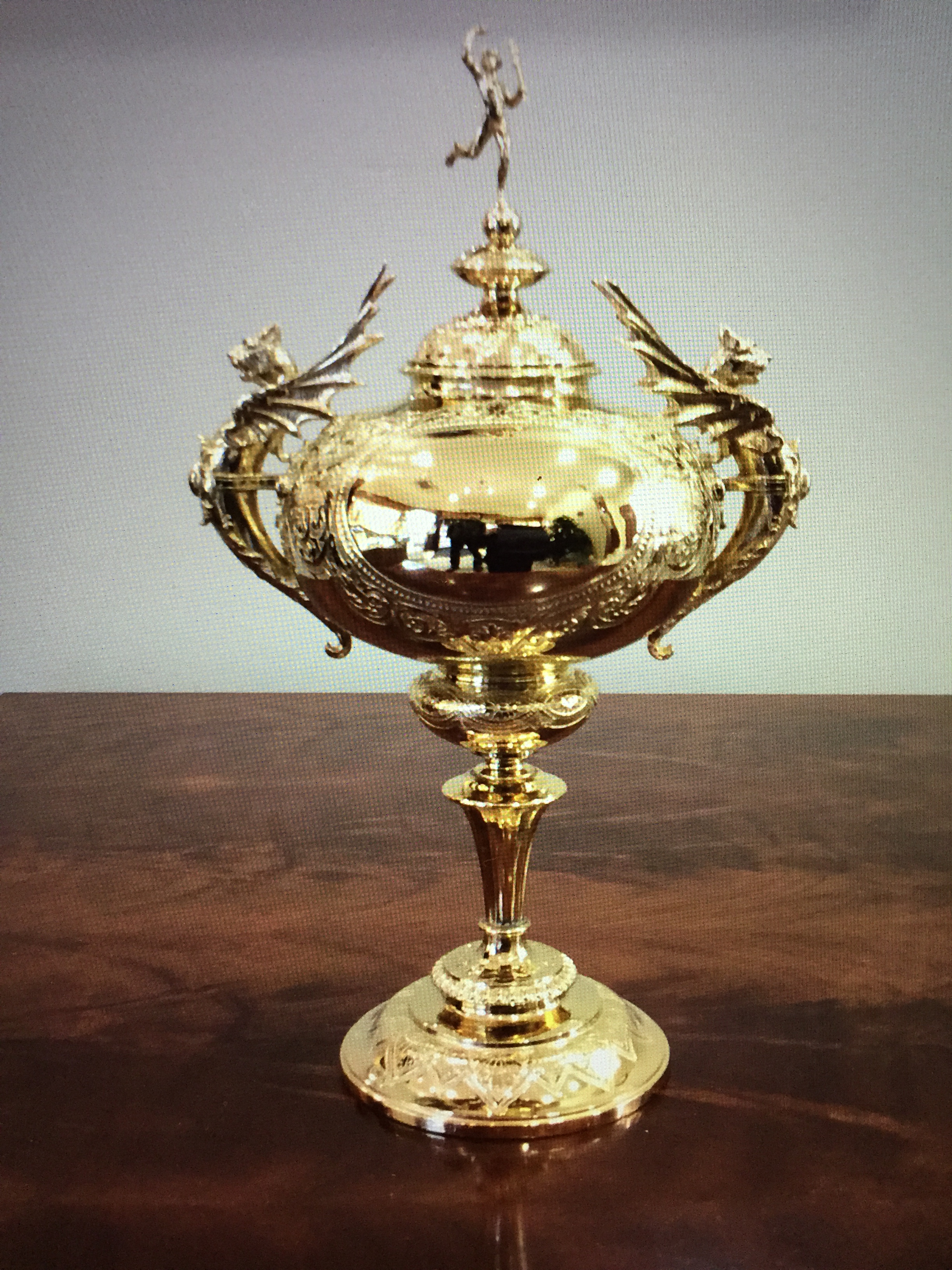
However history will not be forgotten. And in this spirit we were amazed to receive a message from Terry Payne,  whose great-uncle was the remarkable ‘mighty atom’ Tom Payne, who was victorious in the inaugural 1908 Manchester-Blackpool race and again in 1909, 1910, 1911, 1919 and 1920. His first three successive  victories meant he won outright the inaugural trophy. And, lo and behold, Terry has lovingly overseen the restoration of the cup to its former glory.

He writes,

The trophy was given to my Granddad, Tom’s brother and I have always had a keen interest in the history of Tom Payne.

The trophy is inscribed on the back.
T. Payne 1908
T. Payne 1909

On the front the inscription says,
Presented by members of the council of the county borough of Blackpool.

To the winner of the walk from Manchester to Blackpool.  29th February 1908.

Won outright by Tom Payne 1910

The cup is solid silver and has a new coat of 9ct gold plate in it again and looks fantastic! Has been a long time waiting to be able to restore it to its former glory and I am looking to have a new plinth made in the same style as its original.

I hope you all find this as interesting as I have. There is even Pathe news footage showing Tom competing in the walk.

Trophy before restoration


Restored Trophy

We’re crossing fingers that one day Terry might bring the magnificent trophy along to a club race. That would be some event.


Posted in History, News | Tagged , , , | 2 Comments

THE FIRST THIRTY YEARS [PART TWO]

This is the second half of the article on ‘THE FIRST THIRTY YEARS’, written for the 1967/68 Year book. The second paragraph has already appeared on the site as part of the piece on Bobby Bridge, but we have retained it to keep the flow of the original.


A great deal of the club’s history is steeped in the deeds of its walkers, some of whom were great champions in their day.


The first, and probably the greatest of the club’s outstanding performers was R. Bridge.  Bobby Bridge as he was known, was a one-armed postman whose victories and titles could fill a booklet on their own.  Among his most notable triumphs were his A.A.A. titles.  He won the Two miles in 1911-12-13-14 and in 1919, and to add to these he won the Seven miles title in 1912, tied for first place with the celebrated H.V.L. Ross in 1913, won outright again in 1914.  Achieving the A.A.A.’s double three years in succession is an outstanding feat, and but for the war . . . . . who knows?  Bobby’s greatest day was probably the 2nd May, 1914, when at Stamford Bridge, London, he ‘re-wrote’ the British record book from 11 to 15 miles, and also set a world record by covering 15 miles 701 yards in two hours.  This was the same race in which the famous Edgar Houghton of Surrey W.C. set world record figures for twelve hours walking.  Even after his great years Bobby continued to race, but the loss of a leg in a motoring accident in the early 1930’s brought also a great loss to Race Walking.


During the years prior to the first world war, the tall long striding Jack Sutton was also at his peak, and he kept the club to the fore by scoring victories in the Northern Counties (as it was then) 20 miles championship, in 1913 and 1914.


After the war in 1919 activities were resumed, and following closely on the heels of Bobby Bridge, the Lancashire Walking Club produced several men who were to take the club successfully through the 1920’s.  J.Harrop and F.Smith soon made their presence felt in northern track and road sprint events, Smith actually winning the northern Seven track championship in 1923.  1923 was also the year that a new star appeared on the horizon in the person of Joseph Hopkins, undoubtedly one of the greatest  distance walkers the north has ever produced.


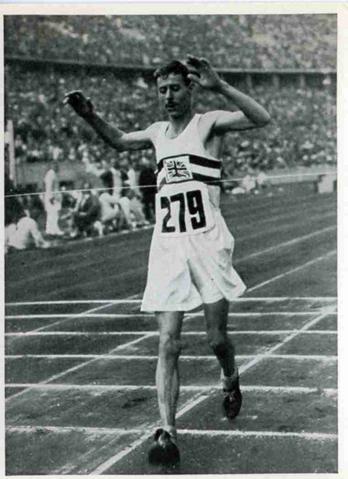
Harold Whitlock 1936 Berlin

Harold Whitlock 1936 Berlin

Joe Hopkins jumped into prominence by finishing third, behind National champion Fred Poynton, and F.Kersley in the 1923 Manchester to Blackpool Walk.  He started his walking career with the North Manchester Harriers, later transferring as a first claim member to the Lancashire Walking Club.  A real honest to goodness walker, Hopkins stayed in the top class of British distance walking for over a decade, winning classic after classic: the Bishop of Birmingham Cup, the Nottingham to Birmingham Walk in 1924, the Manchester to Blackpool Walk in 1926, the Liverpool to Manchester Walks in 1936/37 and the National 20 Miles in 1938.  To this one can add several northern titles as well.  Quite a record, but the race which lingered in many people’s minds was his torrid battle with Harold Whitlock of the Metropolitan W.C. in the 1936 National 50 kilometres.  The race held at Derby was eventually won by Whitlock, but he had to set a new championship record of 4 hours 30 minutes 38 seconds to do so.  Hopkins was also inside the old record less than half a minuted behind, in 4 hours 31 minutes 1 second.  Although second, this performance gained Joe selection for the 1936 Olympic Games in Berlin, where unfortunately he suffered from food poisoning and had to retire from the race.  Harold Whitlock went on to win easily, so one could assume that had Hopkins been one hundred percent  fit, he might well have come home with a medal.


Back to the 1920’s, and the club’s first Manchester to Blackpool Walk winner, Ralph Wallwork who accomplished the feat in 1921.  The club has provided only three winners in the event, and all in the space of seven years.  Arthur Hignet was the ‘third man’ in 1927.  Twenty seven races have been held since Arthur’s victory, and whilst several of our men have come close to winning, the Manchester to Blackpool Walk glory belongs to the men of the twenties.


After the mid-twenties honours of the distance men, the decade closed as it had started with the sprint men in prominence.  In 1928 J.Harop with the Northern Track Seven Miles title, and then along came another grand walker, Leslie Dickinson.  Hailing from the Cumberland fells where he had been handling trail hounds, he joined the club as a novice after taking up residence in Manchester in 1928. He showed a natural aptitude for the sport at once and in 1929 he finished third in the National ‘Junior’ 10 miles championship.  Dickinson virtually monopolised the Northern Two and Seven Miles track championship from that point until well into the thirties.


Much has already been said about the performances of the thirties but among those that haven’t are : George Birchall’s fine northern 50 kilometres victory in 1937 and Tommy Dunne’s National ‘Junior’ 10 miles win at Manchester in 1939.


So much for the first thirty years of the Lancashire Walking Club as recorded through the deeds of its star men – we owe them a great deal.  We owe even more to the many more members who backed up these champions, but who were never champions themselves.  The men without whose backing the many team victories scored by the club could not have been, (although the elusive national team title still eludes the club).*  We owe so much to the men behind the scenes, the officials and committees who through the years have ensured that walkers have been able to practice their sport.  Perhaps in the next Year Book we will be able to look at some of these stalwarts, as well as the second thirty years of the Club.


This then has been a brief history of how the Lancashire Walking Club started, and how efficiently its officials carried out their duties of fostering the sport with the County.  So good was their work that it had repercussions outside the red rose boundary, and it would be quite true to say that the whole northern walking fraternity owes much to the endeavours of those early enthusiasts.


* The elusive national team title was secured at the National 20 kilometres championship in 1970 at Crystal Palace.

Posted in History | Tagged , , , | 3 Comments

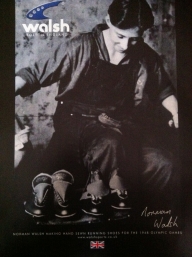
Norman Walsh, Legendary Maker of Race Walking Shoes – RIP

Norman Walsh at the age of 16

Norman Walsh at the age of 16

Tributes to the late Norman Walsh, who died last week at the age of 82, have stressed his remarkable career as an innovative maker of sports shoes.

The Walsh web site notes:

Starting his career at JW Foster in 1945 at age 14, Norman Walsh’s prodigious talent was quickly recognised.  Still at only 16 years old he was selected to make running shoes for the 1948 British Olympic team.  Establishing Norman Walsh Footwear in 1961, Norman went on to develop an incredible diversity of sports footwear for rugby, football, track and field, wrestling, boxing and fell-running. 

We would like to add race walking to that list. From the late 60’s Norman turned his skills to designing and making a bespoke race walking shoe, which was taken up by many, especially in the North. If my memory serves me well I think Ron Wallwork made the first contact with Norman and was instrumental in the birth of the Walsh shoe. At the time Norman worked out of a rambling terraced house on St Helen’s Road, Bolton. To enter its portal was to be drawn into a scene of creative chaos, highlighted by a technicolor of possible uppers strewn on the floorboards, permeated by the intoxicating aroma of leather, suede, rubber and glue. Amidst which Norman worked his magic, happy to meet your requirements in terms of size [drawing around your foot] and colour. I’m pretty sure Norman shod most of the Lancashire WC team that won the 1970 McSweeney Trophy for the best all-round team in the country, whilst a couple of us carried his name into international competition. I’m almost certain too that Ron Wallwork set his 1971 UK 2 hours record in his favourite pair of Walsh’s. And, whilst far from being in the same league I managed to win the British Masters 65-69 5,000 metres the other week in Horwich, wearing a pair of Walsh shoes, made on Norman’s original last, now sold as a ‘designer’ shoe! Norman might well have chuckled at the thought. Finally it’s illuminating to note that you could have the shoes mended over and over again. Recycling, long before the word was coined – a far cry from most modern trainers!

There is a fuller account of Norman’s achievements in this Bolton Evening News obituary.

Tributes to shoe-maker who made footwear for the nation’s sports stars

Any other tales from Walsh wearing race walkers would be much appreciated.

Posted in History | Tagged , , | Leave a comment

Ron Wallwork – May, a month of anniversaries

Ron Wallwork

In the latest edition of the Enfield Walker Ron Wallwork reports on the involvement of Sean Pender and Dan Maskell in our club’s Macclesfield Trophy race on April 26. He goes on to add,

At this venue on 17th May 1958 just a few days before my 17th birthday I made my race Walking debut. The distance was 10 miles. Joe Barraclough, one of many walkers of that era who, because of the scarcity of international opportunity never got the GB vest they deserved, won in 71.56. The runner-up was Ken Matthews 73.03 and Lol Allen 75.57 occupied third place. Over a tough and probably short course I recorded 86.15 in fifteenth position and won the Novice prize which was a butter-dish, which I still possess. 

From this date Ron became central to the club’s journey across the 1960’s and into the 70′ from a sometimes inward looking organisation to becoming a leading force on the northern and national scene. I hope very much to interview Ron about his career in the not too distant future.

On a more personal note this very Saturday, May 31, 2014 witnesses Ron and Joan Wallwork’s Golden Wedding anniversary. I am sure I have everyone at the club’s support in offering Ron and Joan our sincerest congratulations and best wishes for the future.


Posted in History | Tagged , , | 1 Comment

THE FIRST THIRTY YEARS OF THE LANCASHIRE WALKING CLUB [PART ONE]

This account of the opening period in the life of our club appeared in the 1967/68 Year Book, price one shilling!

centurions 1911

THE FIRST THIRTY YEARS [PART ONE]

Shortly after the turn of the century there was a great surge of interest in Race Walking throughout the country, and the county of Lancashire was proving to be quite a ‘hot-bed’ for the sport.  there were several races promoted in the area during this period, and eventually, after some three years or so, a small group of Lancashire business men decided to form a walking club.  It was in fact in the early days of 1904 that these men held a meeting at the Peak Hotel, Manchester, and formed the LANCASHIRE AMATEUR WALKING CLUB.

The newly formed club wasted no time in getting to work and on 16th April, 1904, promoted a 50 miles open scratch and sealed handicap race around north Cheshire. There were thirty entries for the race and among the stars it attracted was the national champion, Jack Butler.  The refreshments provided for the contestants are worthy of note.  the programme stated that “Oxo provided gratis, refreshments without waiting: Oxo athletes’ flasks containing: Oxo ready for consumption while walking, Oxo hot and cold, Oxo and soda, Oxo and champagne, rice pudding made of eggs and milk and rice, cheese, butter, biscuits, bananas, apples, brandy, whisky, champagne, eau-de-cologne and sponges” . . . . . . . . what more could a walker want!

The succeeding three and a half years saw several more successful events staged by the club.  However, a meeting which took place at the Sherwood Hotel, Fallowfield, Manchester, on the 7th November, 1907, the club was reconstituted and the LANCASHIRE WALKING CLUB was born.  “Inaugurated for the encouragement and pastime of walking”, and the motto chosen was “Health the first wealth”.

The very first President the club had was a local M.P., Mr. A.A. Howarth, who was later to become Sir A.A. Howarth.  Two of the most consistent performers of that time, A.R. Edwards and W.J. Jackson were elected as Honorary Secretary and Treasurer respectively. The latter who became known to everyone as Bill was to remain a prominent figure in northern athletic circles until his death in 1965.

With typical Lancashire industry the club was quick of the mark, organising a thirteen and a half miles open handicap race.  The scratch man for this event, which took place on Wednesday the 1st January, 1908, was J.W.E. Bennett the club champion, who was also at the time the reigning Northern Counties 2 miles champion.  Since then, in organisation and promotion of events the Lancashire Walking Club has a very proud record indeed.  The most famous promotion of the club is of course the Manchester to Blackpool Walk.

This race was first held in 1908, when there were 14 entries.  The winner on that occasion was the “mighty atom”, Tom Payne, a truly wonderful walker.  He went on to win the event on six other occasions: 1908-09-10-11, and 1919 and 1920.  great as this feat was, it was equalled, if not surpassed by T.W. Green, who won the race six times in succession: 1929-34.  In his triumph over a course of fifty miles, he set the remarkable time of 7 hours 39 minutes 30 seconds.  Since then this race has attracted over the years many illustrious performers, and this testifies to the esteem with which walkers themselves hold the event.

The 1914-18 war caused havoc with everything, and walking was no exception, but strenuous efforts were made during this time to keep the sport alive.  Numerous races were organised with special prizes for servicemen stationed or living in the area, and thanks to the wonderful efforts of the club officials at that time, it was not until May 1916 that activities had to be suspended. [To be continued.]

 Thanks to Ron Wallwork for digging out the original and Marilyn Taylor for typing up this version for the site.


Posted in History | Tagged , , | Leave a comment

Bobby Bridge : Our First Olympian and World Record Holder

If you go to Google and search for Robert ‘Bobby’ Bridge you will find the limited information below charting his short-lived, but remarkable career.


ogr

Initially a postman, he later qualified as a dentist despite the handicap of his left arm being amputated at the elbow. On his début in the AAA championships in 1912, at the age of 29, he won both the 2 miles and 7 miles walk and he repeated the double in 1913 and 1914. At the 1919 Championships he won the 2 miles for the fourth consecutive time and was the only pre-War champion to retain his title. At the Northern Championships he took the 2 mile/7 mile double four times (1912-14, 1919), won the 2 miles twice more (1921-22), and had a fifth successive win the 7 miles in 1920. In one race at Stamford Bridge in 1914 he broke the world record for every distance from 11 miles to 16 miles (2-05:39.8) and also set a new 2-hour record.Personal Bests: 2 mile Walk – 13:48.8 (1912); 7 mile Walk – 52:06.8 (1914); 2-hour Walk – 24.781 km. (15 m, 701y).

Bobby bridge


In the ‘First Thirty Years’ to be found in the Club’s 1967/68 Year Book this paragraph celebrates his achievements.

The first and possibly the greatest of the club’s outstanding performers was R. Bridge. Bobby Bridge, as he was known, was a one-armed postman, whose victories and titles would fill a booklet on their own. Among his most notable triumphs were his A. A. A. titles. He won the 2 miles title in 1911/12/13/14 and again in 1919 and to add to these he won the 7 miles title in 1912, tied for first place with the celebrated H.L.V. Ross in 1913, winning again outright in 1914. Achieving the A.A.A.’s double three years is an outstanding feat and but for the war….., who knows? Bobby’s greatest day was probably the 2nd of May, 2014, when at Stamford Bridge, London, he rewrote the British record book from 11 to 15 miles and also set a world record by covering 15 miles 701 yards in two hours. This was the same race in which the famous Edgar Horton of surrey W.C. set world record figures for 12 hours walking. Even after his great years Bobby continued to race, but the loss of a leg in a motoring accident in the early 1930’s brought also a great loss to race walking


unnamed

However in a fascinating social history of Liverpool Pembroke Athletic Club, ‘Run Through a Brick Wall, written by Charles Gains, we find out a little more about our hero, along with a discrepancy or two. Here he is said to have endured his tragic accident as early as 1926.

Bobby Bridge was an internationally known walker. Although a member of Pembroke he competed mostly under Lancashire Walking Club which catered for his specialism. He represented Britain at the Stockholm Olympic Games and reportedly held several world records in his day. A tragic accident when he was still competing in 1926 terminated his career. Thereafter he remained steadfastly supporting the club as an official until his death in 1953.

We don’t have a full record of all of Bobby’s performances but here are two:

 30.06.1912 Bridge, Bob Brighton 2 miles(W) 13:48.8 min

31.05.1914 Bridge, Bob Stamford Bridge 15 miles(W) 1hr 56:41.4 min

These would still be considered useful times today !

The Chorley Guardian wrote the following obituary for Bob in 1954 :

Robert Bridge was the oldest of 15 children from Lathom, and moved to Chorley in about1898 where he was a postman and later worked in a dental practice. Robert had a passion for athletic sports and became a self-taught, home trained walker. At the 1912 Olympics in Stockhlom, he took part in the 10km walk, but was disqualified (Robert’s left arm was deformed at birth, which led to suspicions about his walking style and was a possible reason for his disqualification). In the 1913 season, he beat all competition and became Northern Amateur and International Walking Champion. In 1914, he covered 1 mile in 7 min, 21 and 3/5ths seconds to take the world record. He said “My greatest ambition is to win the Olympic Games walking contest for England in 1916″. Unfortunately, he was never to achieve this as the 1916 games, to be hosted in Berlin, did not take place because of the war. Robert was the Amateur Athletic Association champion for 1912, 1913 and 1914 over two miles and seven miles and in 1919 retained the two miles championship. Tragically, in a motorcycle accident in 1926, he lost one ofthe legs that had carried him to fame as an athlete. Although crippled he continued to act as umpire at athletic events until he was 70. He left Chorley to go into business in Liverpool where he died in July 1953.

 By co-incidence Bob was born in Lathom, only yards from the home of Liverpool Pembroke & Sefton Harriers today at Edge Hill.

As Lathom is just up the canal from Wigan on the way to Ormskirk and Southport I’ve done my share of training on the towpaths around the village, but never knew it was Bobby’s birthplace. In retrospect I like to think I was treading in Bobby’s shoes, even if not fit to wear them. Almost exactly 131 years from his birth on April 16 it’s a good time to salute his memory.

Thanks to Trevor McDermot and Ron Wallwork for the links and material.


Posted in History | Tagged , , | 6 Comments

Dipping into Alfred Scorer’s 1951 Reports – A Novice Race included

LWC 1 RonIn the middle picture Jack Sankey of Leigh mentioned in the first report below is on the far left next to Ron Wallwork.

Grateful thanks to Guy Goodair for digging out these reports, despite being on one leg, which though was straight upon contact – more in the pipeline.

Scorer Lancs 2

Alfred Scorer, President of the Lancashire Walking Club, penned a Race Walking column for the journal, ‘Athletics Review’ laced with innocent and amusing turns of phrase – witness his comment below on 71 year old Jack Tempest. “The recent summer has tanned that well developed body of his and many risk a backward glance!”

Scorer 5 25

Scorer 4 NoviceScorer 6 NoviceRon Marsden, who won the Novice Race, remained a pillar of the club for over six decades.

And seeing we are talking novices a plug for Terry and Linda McDermot’s  splendid  initiative, the Teeside Walking League – first 5k race on March 30.

FUN FITNESS WALK(1)

Posted in History | Tagged , , , , | Leave a comment

1967 Revisited – DQ’s, Raffles and Lancashire’s Ironic Good Fortune?

Further to my piece on Lancashire’s overthrow of Sheffield’s Northern 10 miles dominance at Matlock in 1967 memories have been awakened.  Within it I speculated that the disqualification of Wakefield’s Roy Thorpe had opened the way to Lancashire’s success.  Some of those present agree and add spice to the story.

When dq’ed Roy was indeed in a strong position. If he had stayed in the race it is possible Wakefield might have swept to team victory.

Fast forward to the post-race presentations where as usual a raffle was taking place. Drawing the winning ticket was none another than Jim Hackwood, the redoubtable Northern Area official and the judge, who had disqualified Roy. Remember in those days it was one shout and out! However as Jim drew the ticket, he paused and was obliged to put on his spectacles to read out the number.

You can only imagine the look on Roy’s tortured face, guess at the words muttered under his rapid intake of breath. To put it mildly, ” I have just been pulled by a bloke, who can’t see without his specs!” Evidently Guy Goodair and Chris Bolton counselled Roy through his anguish.

Ironically Jim’s decision, for better or worse, meant his beloved Sheffield lost their title to the club on t’other side of the Pennines.

This engaging tale aside race walking in the North and indeed the UK would not have prospered and survived without the often unsung endeavours of both Jim in the past and Roy up to the present. To both much respect and the twinkling of a smile!


Posted in History | Tagged , , | Leave a comment

On Rewriting History and Definitions : A Response

There’s a bit of a hullabaloo going on over at the Race Walking Facebook page about the Race Walking Association’s decision to make this year’s National 50 kilometres championship a ‘B’ classified race. Obviously it is an effort to boost the number competing. In the end I think it is a mistake born of good intentions. If it is a Championship it must be held under Championship rules. However I was irritated by the tone of some of the comments generated, particularly by Quentin Crewe, the leading New Zealand walker, who argues:

This is a real backwards step for UK Racewalking. The RWA has obviously admitted defeat. In making this ‘championship’ a B race, they’re effectively giving up on promoting the sport. They’re giving up on helping any athletes who might be internationally competitive. They should stop calling themselves the Race Walking Association, because the activity they’re organising here is not race walking. Maybe they should rename themselves The Walking Association. I’m not even joking there – remember that the rule states “Race Walking is a progression of steps so taken that the walker makes contact with the ground, so that no visible (to the human eye) loss of contact occurs. The advancing leg shall be straightened (i.e. not bent at the knee) from the moment of first contact with the ground until the vertical upright position.” If you allow bent knees then it isn’t race walking.

Perhaps I’m over-reacting, but the idea that race walking only began in 1996 when the above definition was cobbled together offended my sense of history. Hence I posted the following.

I hesitate to bring to your attention a web site that focuses on the history of a particular British race walking club, whose members thought they were race walking when they complied with the pre-1996 definition, the last 1972 version of which read: ‘Walking is progression by steps so taken that unbroken contact with the ground is maintained. At each step, the advancing foot of the walker must make contact with the ground before the rear foot leaves the ground. During the period of each step when a foot is on the ground, the leg must be straightened (i.e. not bent at the knee) at least for one moment, and in particular, the supporting leg must be straight in the vertical upright position.’

Lest I’m misunderstood I am not arguing for rewinding history. That is absurd. However the implication that a competitor abiding by the 1972 definition was/is a ‘crawler’ or a ‘shuffler, not a real race walker, is patronising and insulting to past generations of athletes. So for what it’s worth, if you are intrigued by the past, you might take a look at https://lancswalkingclub.com/

There isn’t going to be a logical progression to posts. It will simply be an eclectic mix of memories – images and stories.

And if anyone has any photos in the loft of Lancashire walkers I’d be chuffed if you can send them to tonymtaylor@gmail.com

followed by:

There is no doubt that the revision to the definition in 1996 was impelled by the dilemmas of judging at an international level. I’m not one for simplistic connections. Consequences are usually contradictory. However it seems perverse not to recognise that the collapse of numbers competing over the last couple of decades is linked partially to the change in definition. Just because I’ve been looking at the history of the various 10 miles championships we are talking, say, of the loss in a championship of around 200 walkers clocking times between 75 and 95 minutes. These walkers, almost none of which made international level, were the heart and soul of the sport in terms of the individual and team battles of the period. I suspect this collective spirit will never be seen again at a national level. For better or worse race walking seems to be an elite event for the few with a generation of veterans filling out the picture. I’m very happy to be proved mistaken.

Well that’s off my chest – what are your thoughts?

Posted in History | Tagged , , | 2 Comments

The Northern Senior 10 miles : The Tables Turned 1967 – 69

A lovely article on Roland Hardy, Derbyshire Living Legend, rescued from the archives by Trevor and Linda McDermott  brought back to mind a significant  moment in the history of the Northern Ten and the Lancashire Walking Club. The Ten Miles Senior Championship had been inaugurated in 1949 and throughout the fifties and into the sixties Sheffield ruled the roost. The first race held in Derby had seen Johnny Proctor victorious in 76 :14, beating surprisingly the mercurial Lol Allen, who himself a fortnight later became national champion in 75 :09 at Leicester.  Sheffield United Harriers supplied the first ten men home in the northern championship with their ‘A’ and ‘B’ teams taking first and second with the Derbyshire WC third. Lancashire could only manage fourth. Moving forward to 1966, whilst Ron Wallwork won by a street in 75:29, Sheffield still placed 7 walkers in the first ten, the other two individuals being Guy Goodair and John Paterson from Wakefield, who finished 3rd team behind the red and white hooped ‘A’ and ‘B’ squads. Sheffield’s domination seemed set in stone.

Thus Sheffield were stunned to lose their title in 1967 on a hilly course at Matlock. Indeed such was the surprise that Peter Keeling, the Guardian’s athletic correspondent of the time, wrote a special piece headlined ‘The longest winning streak in any sport comes to an end!’. Led by a rampant Ron Wallwork, who was to become national champion on his home turf a fortnight later and future national coach, Julian Hopkins, Lancashire packed well to pip Sheffield.  Our cause was helped by the impressive performances of Guy Goodair, George Barrass, both of Wakefield and the young Phil Bannan from the Isle of Man, which pushed the first Sheffield counter back into sixth place. And in truth, if Roy Thorpe had not been disqualified, it might well have been Wakefield’s quartet bringing Sheffield’s winning sequence to a close! As it was Wakefield wreaked sweet revenge in the National 10 at Bolton beating Lancashire by one point to take the third team, the club’s first championship medals. More were to follow in ensuing years at the longer distances.

Ron Wallwork

1. R. Wallwork [LWC] 75:00 2. Guy Goodair [Wake] 77:43 3. George Barras [Wake] 77:57 4. Julian Hopkins [LWC] 78:15 5. Phil Bannan [Boundary] 78:31 6. Jim Stancer [Sheff] 79:43 7. Arthur Etches [Sheff] 80:16 8. Mick Barker [Sheff] 80:24 9. John Todd [LWC] 10. Jake Warhurst [Sheff] 81:53 11. John Hampshire [Wake] 81:58 12. Mick Greasley [Sheff] 82:45 13. Johnny Proctor [Sheff] 82:59 14. Tony Taylor [LWC] 83:12 15. Harry Wheeler [YWC] 83:44.

Teams 1. LWC 25 2. Sheff UH 29 3. Wakefield 47    46 started 4DQ.

Roland Hardy

Obviously Sheffield were not going to take this rebuff to their prestige lightly, which is where Roland Hardy returned to centre stage. As you might have gleaned from the 1967 result Sheffield had already persuaded the 1949 winner, Johnny Proctor to return to the fold. Roland was soon to follow.  In 1968 once more in the picturesque village of Holloway, near Matlock the Sheffield ‘old guard’ led by the rising star Jake Warhurst hit back with a vengeance. From somewhere Roland Hardy produced a sub-75 minute performance to finish second. Although Lancashire placed 4 in the top ten their inspirational leader Ron Wallwork endured a disappointing race in what was to be a frustrating and traumatic Olympic year.  With Mick Greasley and Proctor dipping under 80 minutes Sheffield regained their trophy by a single point.  Normal service had been resumed.

1. Jake Warhurst [Sheff] 73:51 2. Roland Hardy [Sheff] 74:44 3. Phil Bannan [Boundary] 75:58 4. Roy Thorpe [Wake] 76:35 5. Ron Wallwork [LWC] 77:24 6. Don Warren [LWC] 78:23 7. George Barras [Wake] 78:39 8. Tony Taylor [LWC] 78 :49 9. Mike Hatton [LWC] 78:55 10. Mick Greasley [Sheff] 79:26 11. Guy Goodair [Wake] 79:30 12. Johnny Proctor [Sheff] 79:37 13. John Eddershaw [Sheff] 79:57 14. Arthur Etches [Sheff] 79:59 15. Julian Hopkins [LWC] 80:14

Teams 1 Sheffield UH 23 2. LWC 24 3. Wakefield 47    54 finishers

However the tables were to be turned again in 1969 at Sutton Macclesfield on what was described in the Race Walking Record as ‘a rather stiff course’. Jake Warhurst continued to cement his reputation with a clear victory over the chasing Lancastrian duo of Tony Taylor and Ron Wallwork, the former recording one of his few successes over his illustrious team-mate. As it was this race signaled Ron’s emergence from the post-Mexico doldrums on the way to a remarkable season in 1971 – but that’s a story for another day. And for the Lancashire team itself this win pointed to one of its finest moments, a national team title – and again that’s another tale to tell. What was telling on the day was the absence of Sheffield’s stalwarts of perhaps its golden age. The Yorkshire club was never to achieve such heights of dominance again.

Jake Warhurst leads Tony Taylor with Mick Holmes hidden

Jake Warhurst leads Tony Taylor with Mick Holmes hidden

1. Jake Warhurst [Sheff] 74:20 2. Tony Taylor [LWC] 76:10 3. Ron Wallwork [LWC] 76:34 4. Roy Thorpe [Wake] 76:47 5. Phil Bannan [Boundary] 76:52 6. Guy Goodair [Wake] 77:47 7. Phil Etches [Sheff] 78:15 8. Dave Vickers [LWC] 79:10 9. Don Warren [LWC] 79:31 10. Mick Barker [Sheff] 80:39 11. George Barras [Wake] 81:05 12. Jeff Ford [Sheff] 81:22 13.  Arthur Etches [Sheff] 81:31 14. Mick Holmes [Yorks WC] 81:49 15. John Grayson [Wake] 82:17.

Teams 1.LWC ‘A’ 20 2. Sheffield UH ‘A’ 27 3. Wakefield 33.      46 Finishers

As I pen these reminiscences it is upsetting to hear that the Northern Senior 10, a classic race in its time, might be withdrawn from the calendar. Only five walkers started the race a few weeks ago.

Posted in History | Tagged , , , , , | Leave a comment