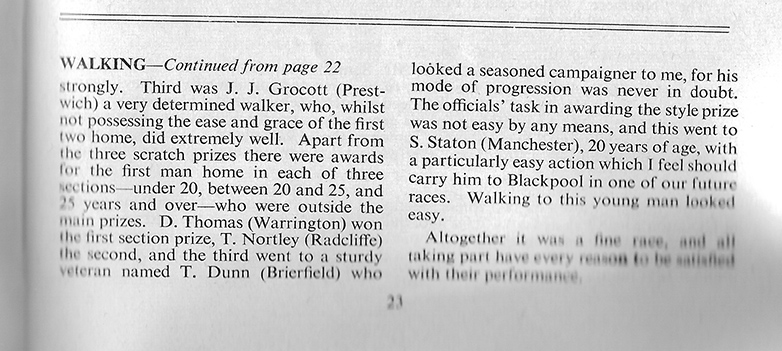
Dipping into Alfred Scorer’s 1951 Reports – A Novice Race included

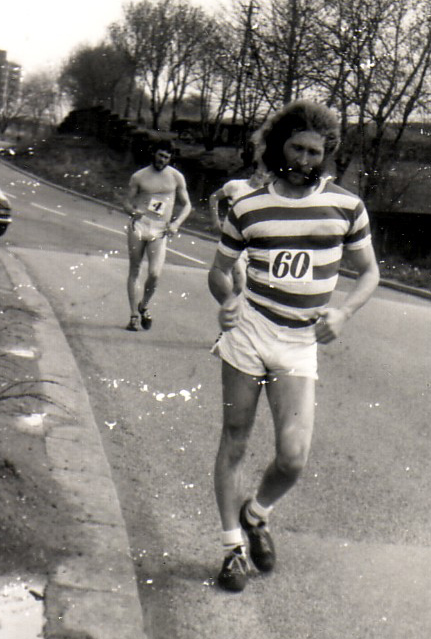
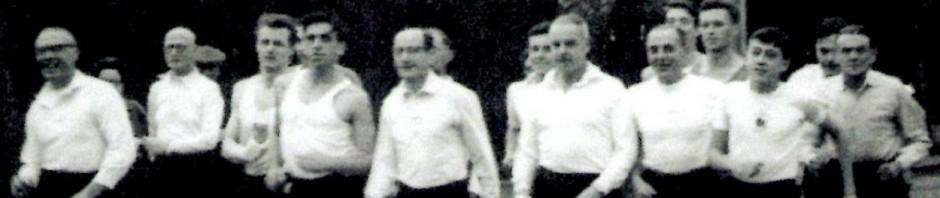
LWC 1 RonIn the middle picture Jack Sankey of Leigh mentioned in the first report below is on the far left next to Ron Wallwork.

Grateful thanks to Guy Goodair for digging out these reports, despite being on one leg, which though was straight upon contact – more in the pipeline.

Scorer Lancs 2

Alfred Scorer, President of the Lancashire Walking Club, penned a Race Walking column for the journal, ‘Athletics Review’ laced with innocent and amusing turns of phrase – witness his comment below on 71 year old Jack Tempest. “The recent summer has tanned that well developed body of his and many risk a backward glance!”

Scorer 5 25

Scorer 4 NoviceScorer 6 NoviceRon Marsden, who won the Novice Race, remained a pillar of the club for over six decades.

And seeing we are talking novices a plug for Terry and Linda McDermot’s  splendid  initiative, the Teeside Walking League – first 5k race on March 30.

FUN FITNESS WALK(1)

Posted in History | Tagged , , , , | Leave a comment

1967 Revisited – DQ’s, Raffles and Lancashire’s Ironic Good Fortune?

Further to my piece on Lancashire’s overthrow of Sheffield’s Northern 10 miles dominance at Matlock in 1967 memories have been awakened.  Within it I speculated that the disqualification of Wakefield’s Roy Thorpe had opened the way to Lancashire’s success.  Some of those present agree and add spice to the story.

When dq’ed Roy was indeed in a strong position. If he had stayed in the race it is possible Wakefield might have swept to team victory.

Fast forward to the post-race presentations where as usual a raffle was taking place. Drawing the winning ticket was none another than Jim Hackwood, the redoubtable Northern Area official and the judge, who had disqualified Roy. Remember in those days it was one shout and out! However as Jim drew the ticket, he paused and was obliged to put on his spectacles to read out the number.

You can only imagine the look on Roy’s tortured face, guess at the words muttered under his rapid intake of breath. To put it mildly, ” I have just been pulled by a bloke, who can’t see without his specs!” Evidently Guy Goodair and Chris Bolton counselled Roy through his anguish.

Ironically Jim’s decision, for better or worse, meant his beloved Sheffield lost their title to the club on t’other side of the Pennines.

This engaging tale aside race walking in the North and indeed the UK would not have prospered and survived without the often unsung endeavours of both Jim in the past and Roy up to the present. To both much respect and the twinkling of a smile!


Posted in History | Tagged , , | Leave a comment

On Rewriting History and Definitions : A Response

There’s a bit of a hullabaloo going on over at the Race Walking Facebook page about the Race Walking Association’s decision to make this year’s National 50 kilometres championship a ‘B’ classified race. Obviously it is an effort to boost the number competing. In the end I think it is a mistake born of good intentions. If it is a Championship it must be held under Championship rules. However I was irritated by the tone of some of the comments generated, particularly by Quentin Crewe, the leading New Zealand walker, who argues:

This is a real backwards step for UK Racewalking. The RWA has obviously admitted defeat. In making this ‘championship’ a B race, they’re effectively giving up on promoting the sport. They’re giving up on helping any athletes who might be internationally competitive. They should stop calling themselves the Race Walking Association, because the activity they’re organising here is not race walking. Maybe they should rename themselves The Walking Association. I’m not even joking there – remember that the rule states “Race Walking is a progression of steps so taken that the walker makes contact with the ground, so that no visible (to the human eye) loss of contact occurs. The advancing leg shall be straightened (i.e. not bent at the knee) from the moment of first contact with the ground until the vertical upright position.” If you allow bent knees then it isn’t race walking.

Perhaps I’m over-reacting, but the idea that race walking only began in 1996 when the above definition was cobbled together offended my sense of history. Hence I posted the following.

I hesitate to bring to your attention a web site that focuses on the history of a particular British race walking club, whose members thought they were race walking when they complied with the pre-1996 definition, the last 1972 version of which read: ‘Walking is progression by steps so taken that unbroken contact with the ground is maintained. At each step, the advancing foot of the walker must make contact with the ground before the rear foot leaves the ground. During the period of each step when a foot is on the ground, the leg must be straightened (i.e. not bent at the knee) at least for one moment, and in particular, the supporting leg must be straight in the vertical upright position.’

Lest I’m misunderstood I am not arguing for rewinding history. That is absurd. However the implication that a competitor abiding by the 1972 definition was/is a ‘crawler’ or a ‘shuffler, not a real race walker, is patronising and insulting to past generations of athletes. So for what it’s worth, if you are intrigued by the past, you might take a look at https://lancswalkingclub.com/

There isn’t going to be a logical progression to posts. It will simply be an eclectic mix of memories – images and stories.

And if anyone has any photos in the loft of Lancashire walkers I’d be chuffed if you can send them to tonymtaylor@gmail.com

followed by:

There is no doubt that the revision to the definition in 1996 was impelled by the dilemmas of judging at an international level. I’m not one for simplistic connections. Consequences are usually contradictory. However it seems perverse not to recognise that the collapse of numbers competing over the last couple of decades is linked partially to the change in definition. Just because I’ve been looking at the history of the various 10 miles championships we are talking, say, of the loss in a championship of around 200 walkers clocking times between 75 and 95 minutes. These walkers, almost none of which made international level, were the heart and soul of the sport in terms of the individual and team battles of the period. I suspect this collective spirit will never be seen again at a national level. For better or worse race walking seems to be an elite event for the few with a generation of veterans filling out the picture. I’m very happy to be proved mistaken.

Well that’s off my chest – what are your thoughts?

Posted in History | Tagged , , | 2 Comments

The Northern Senior 10 miles : The Tables Turned 1967 – 69

A lovely article on Roland Hardy, Derbyshire Living Legend, rescued from the archives by Trevor and Linda McDermott  brought back to mind a significant  moment in the history of the Northern Ten and the Lancashire Walking Club. The Ten Miles Senior Championship had been inaugurated in 1949 and throughout the fifties and into the sixties Sheffield ruled the roost. The first race held in Derby had seen Johnny Proctor victorious in 76 :14, beating surprisingly the mercurial Lol Allen, who himself a fortnight later became national champion in 75 :09 at Leicester.  Sheffield United Harriers supplied the first ten men home in the northern championship with their ‘A’ and ‘B’ teams taking first and second with the Derbyshire WC third. Lancashire could only manage fourth. Moving forward to 1966, whilst Ron Wallwork won by a street in 75:29, Sheffield still placed 7 walkers in the first ten, the other two individuals being Guy Goodair and John Paterson from Wakefield, who finished 3rd team behind the red and white hooped ‘A’ and ‘B’ squads. Sheffield’s domination seemed set in stone.

Thus Sheffield were stunned to lose their title in 1967 on a hilly course at Matlock. Indeed such was the surprise that Peter Keeling, the Guardian’s athletic correspondent of the time, wrote a special piece headlined ‘The longest winning streak in any sport comes to an end!’. Led by a rampant Ron Wallwork, who was to become national champion on his home turf a fortnight later and future national coach, Julian Hopkins, Lancashire packed well to pip Sheffield.  Our cause was helped by the impressive performances of Guy Goodair, George Barrass, both of Wakefield and the young Phil Bannan from the Isle of Man, which pushed the first Sheffield counter back into sixth place. And in truth, if Roy Thorpe had not been disqualified, it might well have been Wakefield’s quartet bringing Sheffield’s winning sequence to a close! As it was Wakefield wreaked sweet revenge in the National 10 at Bolton beating Lancashire by one point to take the third team, the club’s first championship medals. More were to follow in ensuing years at the longer distances.
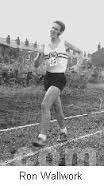
Ron Wallwork

1. R. Wallwork [LWC] 75:00 2. Guy Goodair [Wake] 77:43 3. George Barras [Wake] 77:57 4. Julian Hopkins [LWC] 78:15 5. Phil Bannan [Boundary] 78:31 6. Jim Stancer [Sheff] 79:43 7. Arthur Etches [Sheff] 80:16 8. Mick Barker [Sheff] 80:24 9. John Todd [LWC] 10. Jake Warhurst [Sheff] 81:53 11. John Hampshire [Wake] 81:58 12. Mick Greasley [Sheff] 82:45 13. Johnny Proctor [Sheff] 82:59 14. Tony Taylor [LWC] 83:12 15. Harry Wheeler [YWC] 83:44.

Teams 1. LWC 25 2. Sheff UH 29 3. Wakefield 47    46 started 4DQ.

Roland Hardy

Obviously Sheffield were not going to take this rebuff to their prestige lightly, which is where Roland Hardy returned to centre stage. As you might have gleaned from the 1967 result Sheffield had already persuaded the 1949 winner, Johnny Proctor to return to the fold. Roland was soon to follow.  In 1968 once more in the picturesque village of Holloway, near Matlock the Sheffield ‘old guard’ led by the rising star Jake Warhurst hit back with a vengeance. From somewhere Roland Hardy produced a sub-75 minute performance to finish second. Although Lancashire placed 4 in the top ten their inspirational leader Ron Wallwork endured a disappointing race in what was to be a frustrating and traumatic Olympic year.  With Mick Greasley and Proctor dipping under 80 minutes Sheffield regained their trophy by a single point.  Normal service had been resumed.

1. Jake Warhurst [Sheff] 73:51 2. Roland Hardy [Sheff] 74:44 3. Phil Bannan [Boundary] 75:58 4. Roy Thorpe [Wake] 76:35 5. Ron Wallwork [LWC] 77:24 6. Don Warren [LWC] 78:23 7. George Barras [Wake] 78:39 8. Tony Taylor [LWC] 78 :49 9. Mike Hatton [LWC] 78:55 10. Mick Greasley [Sheff] 79:26 11. Guy Goodair [Wake] 79:30 12. Johnny Proctor [Sheff] 79:37 13. John Eddershaw [Sheff] 79:57 14. Arthur Etches [Sheff] 79:59 15. Julian Hopkins [LWC] 80:14

Teams 1 Sheffield UH 23 2. LWC 24 3. Wakefield 47    54 finishers

However the tables were to be turned again in 1969 at Sutton Macclesfield on what was described in the Race Walking Record as ‘a rather stiff course’. Jake Warhurst continued to cement his reputation with a clear victory over the chasing Lancastrian duo of Tony Taylor and Ron Wallwork, the former recording one of his few successes over his illustrious team-mate. As it was this race signaled Ron’s emergence from the post-Mexico doldrums on the way to a remarkable season in 1971 – but that’s a story for another day. And for the Lancashire team itself this win pointed to one of its finest moments, a national team title – and again that’s another tale to tell. What was telling on the day was the absence of Sheffield’s stalwarts of perhaps its golden age. The Yorkshire club was never to achieve such heights of dominance again.

Jake Warhurst leads Tony Taylor with Mick Holmes hidden

Jake Warhurst leads Tony Taylor with Mick Holmes hidden

1. Jake Warhurst [Sheff] 74:20 2. Tony Taylor [LWC] 76:10 3. Ron Wallwork [LWC] 76:34 4. Roy Thorpe [Wake] 76:47 5. Phil Bannan [Boundary] 76:52 6. Guy Goodair [Wake] 77:47 7. Phil Etches [Sheff] 78:15 8. Dave Vickers [LWC] 79:10 9. Don Warren [LWC] 79:31 10. Mick Barker [Sheff] 80:39 11. George Barras [Wake] 81:05 12. Jeff Ford [Sheff] 81:22 13.  Arthur Etches [Sheff] 81:31 14. Mick Holmes [Yorks WC] 81:49 15. John Grayson [Wake] 82:17.

Teams 1.LWC ‘A’ 20 2. Sheffield UH ‘A’ 27 3. Wakefield 33.      46 Finishers

As I pen these reminiscences it is upsetting to hear that the Northern Senior 10, a classic race in its time, might be withdrawn from the calendar. Only five walkers started the race a few weeks ago.
Posted in History | Tagged , , , , , | Leave a comment

The Leyland Legacy

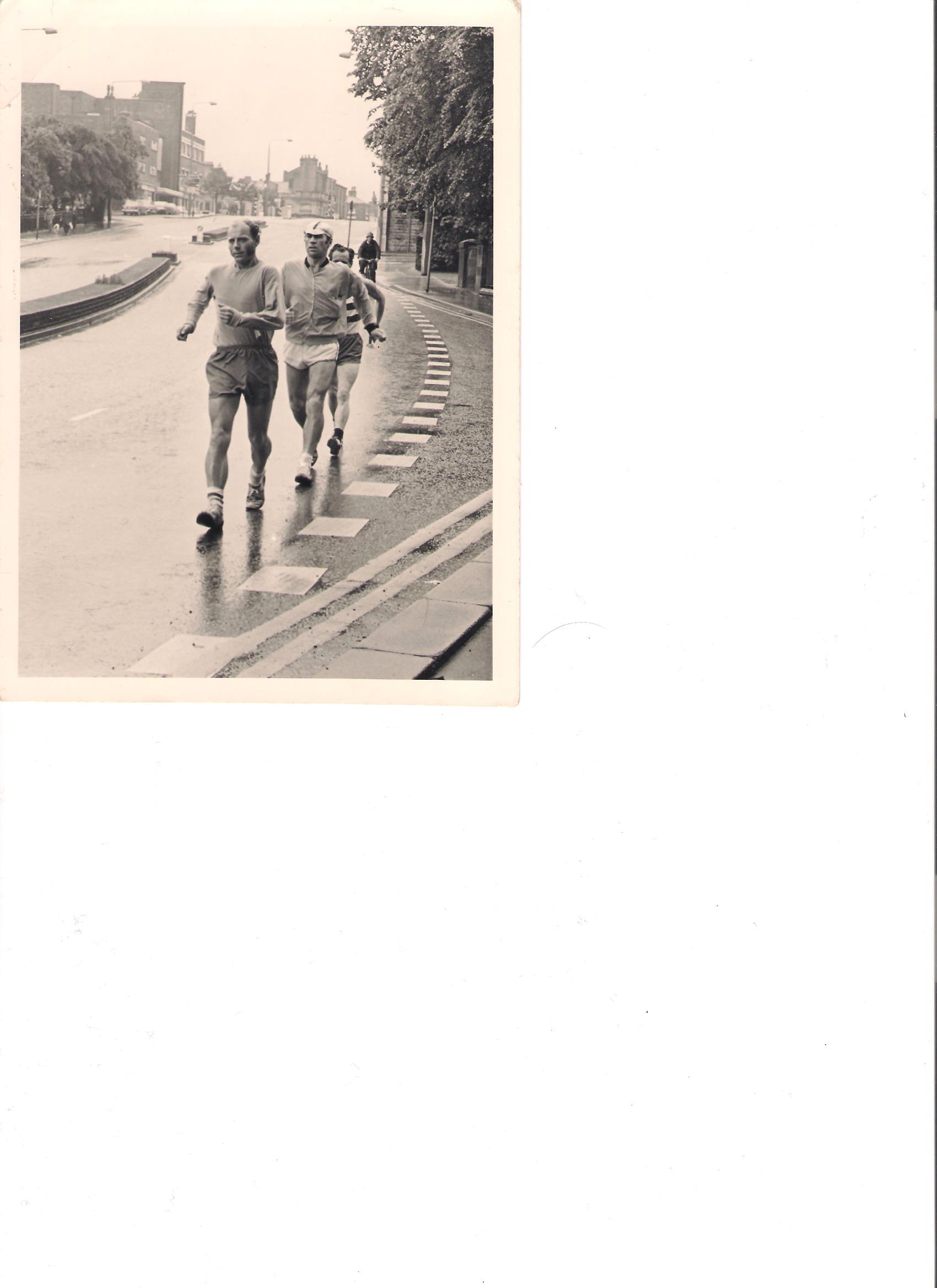
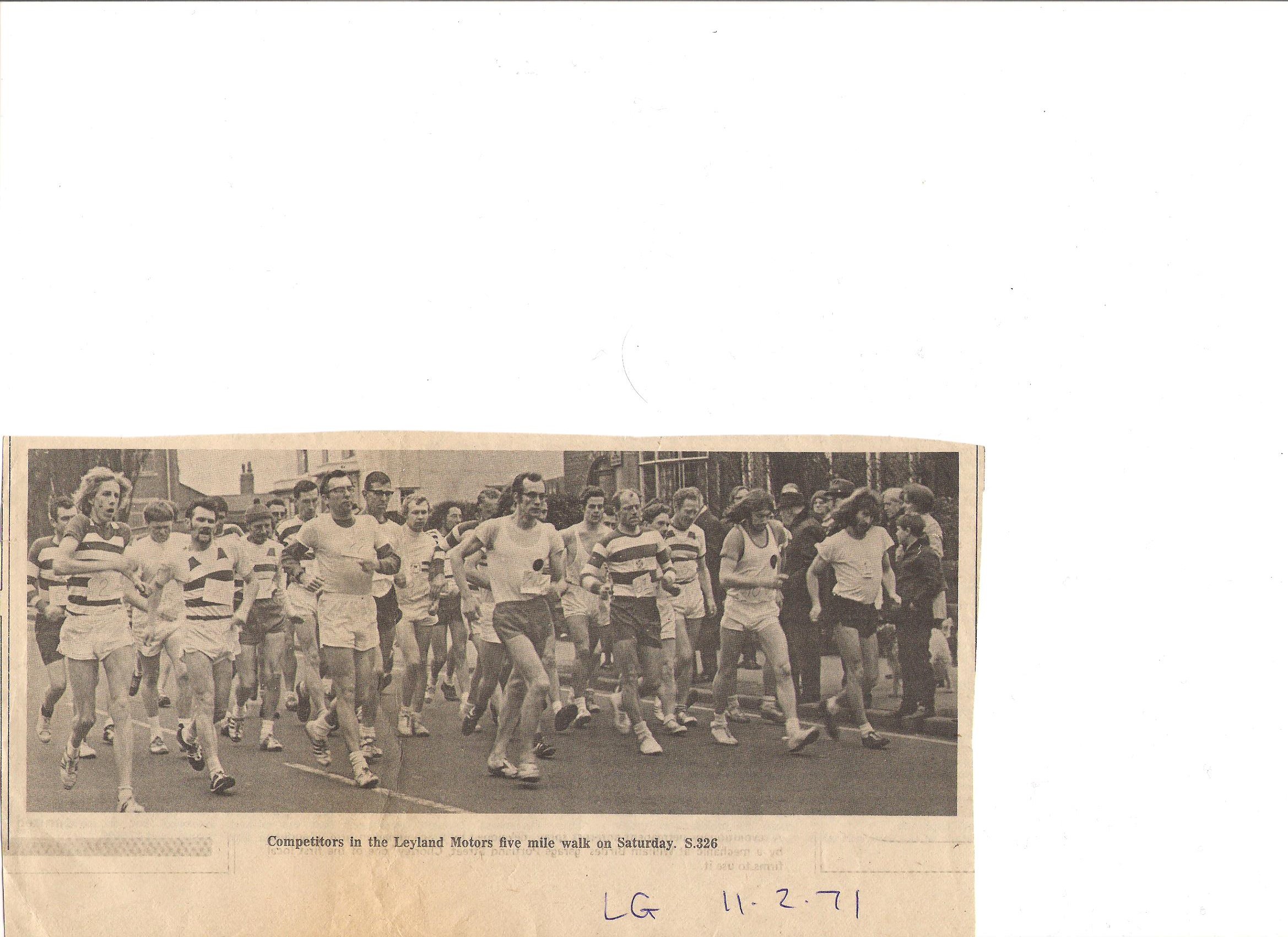
You will find below a few photos from Eric Crompton’s bottom drawer. Simply receiving them from Dave, his son, poses the question of whether the title of our web site ought to be ‘Race Walking in Lancashire’? Whilst the Lancashire Walking Club has been the dominant name in the county a number of other clubs have been significant, notably the Leyland Motors Athletic Club, Leigh Harriers, Bolton United Harriers and albeit briefly Blackburn Athletic Club. Over the coming months it will be interesting to tease out the relationship between these clubs.

For the moment these images hint at the independent role played by the Leyland Club in the decades after the Second World War. Any materials pertaining to the history of the club, a child of the philanthropic period when  major employers such as Leyland Motors provided a range of social, cultural and sporting facilities for their workers, would be greatly appreciated. For example the Leyland Motors Brass Band was in its time justly famous. I wonder when the walking club was formed.  Are there any records of its history?

Eric passing through Chorley in the Blackpool Walk

Eric passing through Chorley in the Blackpool Walk

Start of the Leyland Five Miles 1971

Start of the Leyland Five Miles 1971


Posted in History | Tagged , | 4 Comments

MAKING A START : Raiding your lofts, cellars and craniums!

LWC 1 Ron

The idea of  bringing back to life the rich and diverse history of the Lancashire Walking Club founded in 1907 has been around for quite a few years. However to do so has seemed an uphill task. Stalwarts of the past have passed away with the club records seemingly accompanying them into oblivion. However the idea has been sparked once more into life ironically by the death of a great clubman, Cliff Royle, who a decade ago had sent Ron Wallwork an evocative recollection of his athletic days. Following Cliff’s funeral Ron shared these memories with a number of today’s club members. Such has been the impact of Cliff’s tribute to ‘The Tough Men of the Road’ that we have decided to have a crack at collecting together on this site anything and everything pertaining to the club’s history, be it photos, articles, results or simply a personal memory you want to share.  For the time being we will post stuff as it arrives with no sense of trying to put it in any logical order. If that happens down the line, it will be a bonus. Thus we would encourage you to raid your lofts and your minds – send stuff to Tony at tonymtaylor@gmail.com.  If we get our act together we might also begin using a facility called Drop Box, which allows folk to send bigger files. So watch this space.

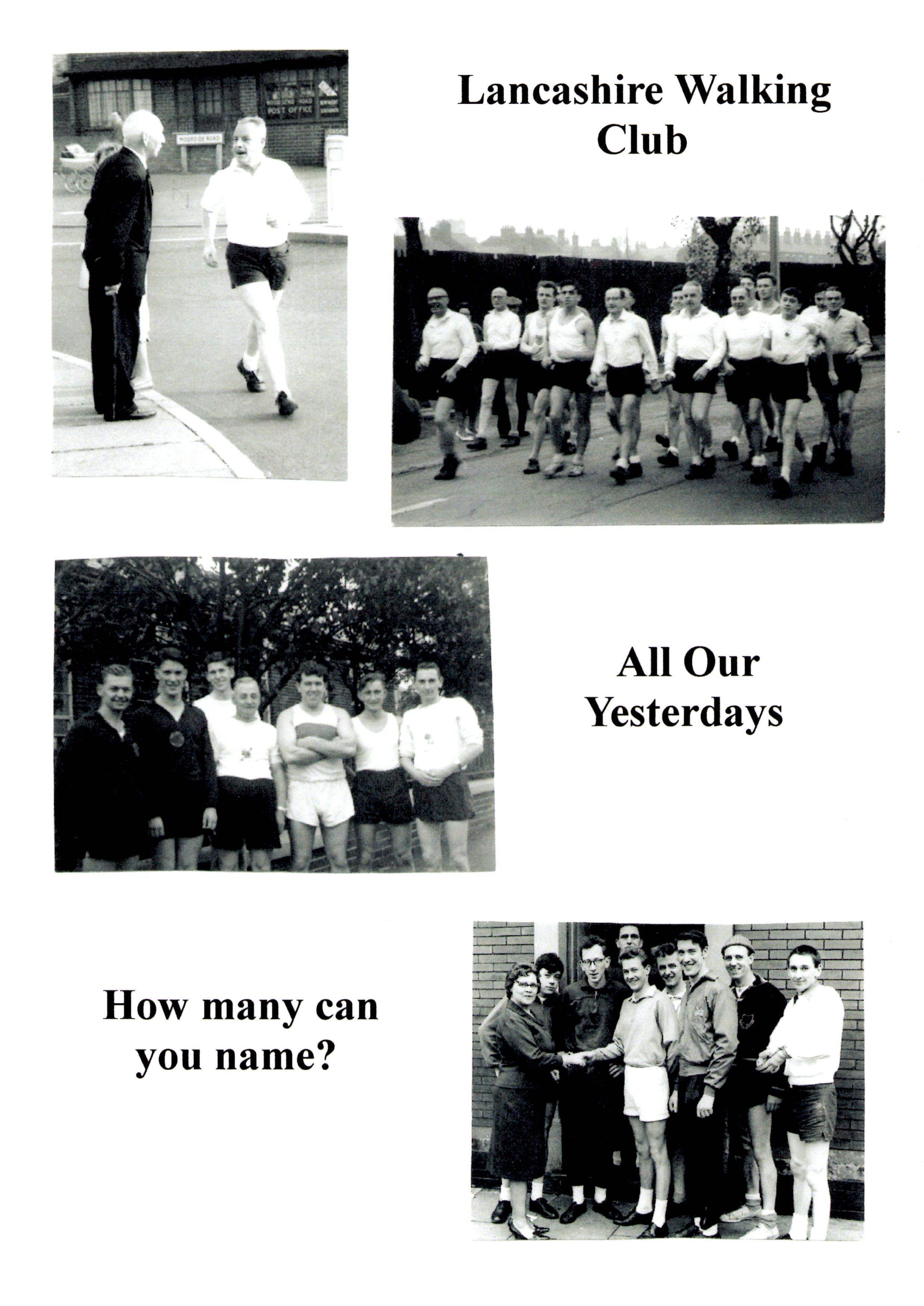
Thanks to Ron Wallwork for the first of several photo montages. Attempted answers to the question gratefully received! I’ll have a go in the next few days.

Posted in History | Tagged , , | 2 Comments