Remembering Vladimir Golubnichy, a true legend

The legendary Vladimir Golubnichy died on Monday, August 16 at the age of 85. There’s an outstanding tribute to his memory by Tim Erickson on the latest Victoria RWC Newsletter. It begins:

Born on 2nd June 1936, Golubnichiy medalled at four Olympic Games (2 golds, 1 silver and 1 bronze), three European championships (gold, silver and bronze) and 2 Lugano Cups (2 silvers). He bettered the 20km World Record on 3 occasions, with two of those performances ratified as official records: 1:30:02.8 (02/10/1955, Kiev) and 1:27:05.0 (23/09/1958, Simferopol).

Read it in full by subscribing to the Newsletter, which is a mine of information and analysis via Tim at tim.erickson02@gmail.com

As it is remembering Vladimir took me back to a booklet, ‘Race Walking 1971’ put together over 50 years ago by Julian Hopkins and myself with Ron Wallwork type-setting. Within its pages Julian offered a piece on Golubnichy’s career up to that date. It seems fitting to revive Julian’s article.
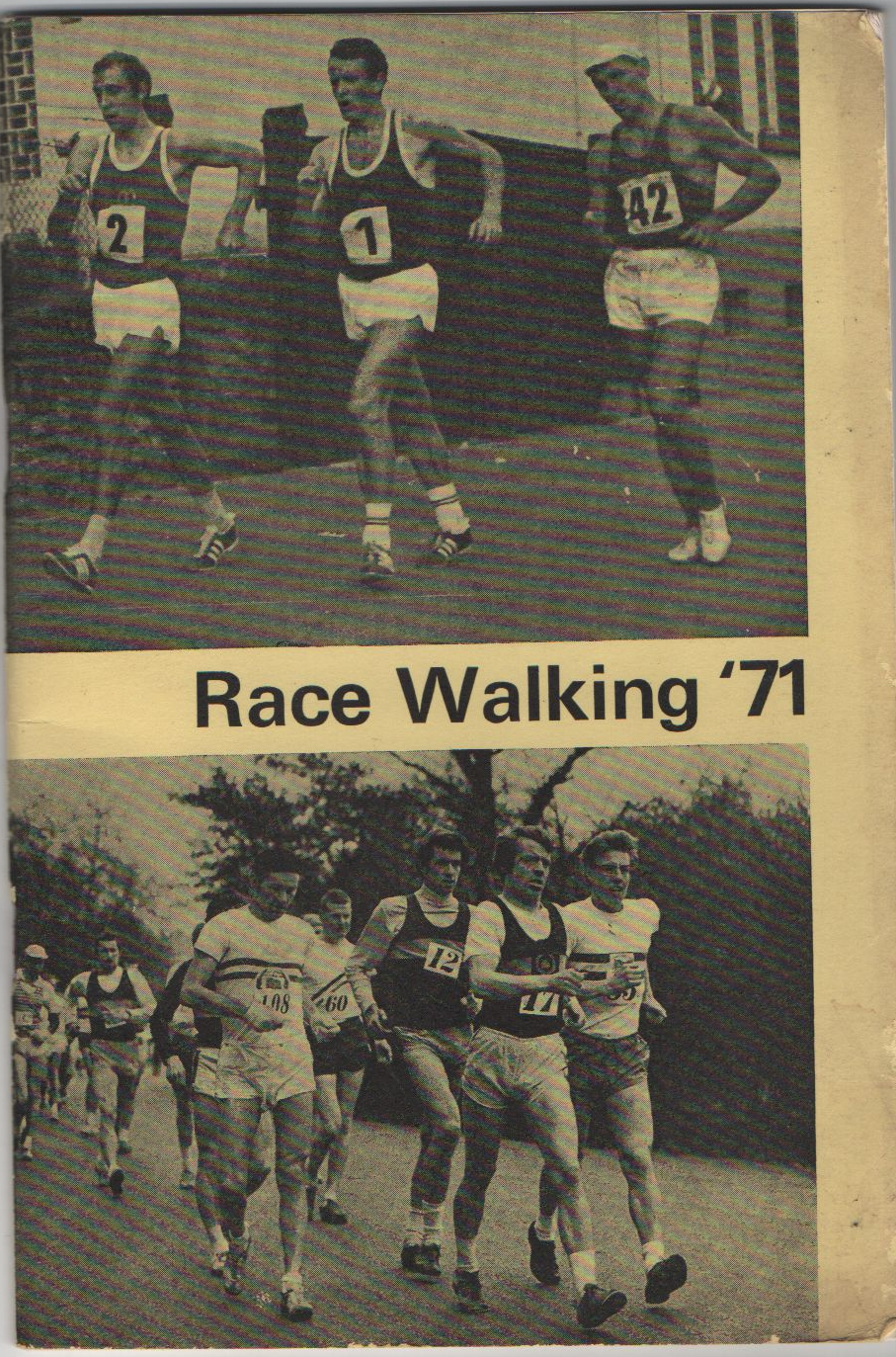
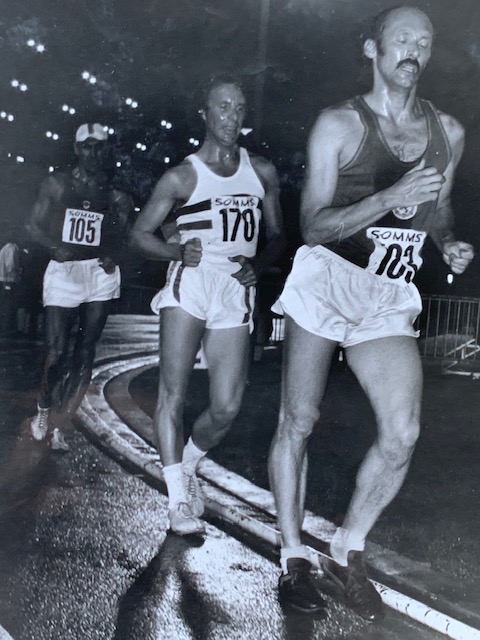
Top photo from L/R Reimann, Frenkel and Golubnichy.. Below early in the GLC 10 leading quartet of Nihill, Lawton, Wesch and Lightman with Sutherland close at hand

Vladimir Golubnichiy

Vladimir Golubnichiy, one of the great walkers of all time, was born at Sumy in the Ukraine on 2nd June, 1936. Volleyball and basketball first captured his attention, but in 1953 – aged 17 – he turned to walking guided by Polyakov, who still coaches him today. Outstanding results soon followed, for in the following year he covered 10 kms in 44:51.6 whilst 1955 saw Golubnichiy capture the world record for 20 kms. With a time of 90:02.8 he had become a world record holder at the precocious age, for a walker, of 19 years.

Nothing was heard of the Ukrainian in 1956 and the following season, although he took fourth in the Soviet championships, as he achieved little of great note. It was a different story in 1958 for as well as capturing the national title, Golubnichiy set a new world standard of 87:05 – a mark that remained on the books until 1969! True, he did go faster with 86:13.2 in 1959 but this mark, for some reason or other, never received ratification. Also in 1959 he made his international debut, winning easily against the U.S.A. – a victory he was to repeat in this match in 1962 and 1964.

Up to this time, Golubnichiy had proved himself to be the fastest 20 kms walker in history, but the stopwatch is not the ultimate judge of an athlete. How good a competitor was he? Was he just another Soviet walker who could record incredible times at home and yet fail to show the same pace in international competition?

The following year, 1960, was Olympic year and the Games were due to be held in Rome. Despite only finishing fifth (in 89:37!) in one of the trial races, the selectors had faith in his ability and he gained a place in the powerful U.S.S.R. team. The race was itself held on a hot, humid day which accounted indirectly for the failure of our own Ken Matthews. Setting a very brisk pace, the Briton led until just before half distance when he was overhauled by Golubnichiy. The after effects of ‘flu had weakened Matthews who later collapsed, whilst the muscular Ukrainian had built up a commanding lead by the 15 kms mark. With just 4 kms remaining he too began to suffer from the fast pace, and fading rapidly had to pull out all the stops to hold off the surprising 21 year old Australian Noel Freeman by 9.4 seconds. The winning time of 94:07.2, over 2.5 minutes outside the Olympic record, showed how slow conditions were on the day.

With not a great deal at stake, the following season was a quiet one for the Olympic champion. Never approaching top form he could place no higher than fifth in the National championships. Early in 1962, however, Golubnichiy began to show something like his best form when recording 42:47.8 for 10 kms on Leningrad’s indoor 200m track. In the big Znamenskiy Memorial meeting in July, his time for 20 kms was 89:16, whilst second place to Vedyakov in the U.S.S.R. championships earned him selection for the European Championships in Belgrade. This particular race was a big triumph for Ken Matthews who partly atoned for his disappointment in Rome by winning in 95:54.8 – the slow time a result of a hot day and a severe course. The Olympic champion never got on terms with the British star but looked set for the silver medal until overhauled nearing the finish by 21 year old Hans-Georg Reimann (East Germany), the surprise packet of the race. He did manage however to salvage the bronze by holding off his fast-finishing team-mate, Anatoliy Vedyakov.

Golubnichiy was not in his best form in 1963 although he did show that he was still a force to be reckoned with by gaining second place at the national championships in a season’s best of 92:02. In passing it might be noted that in July, during the Znamenskiy meeting, he suffered disqualification – the only one of his entire career!

He warmed up for the defence of his Olympic title in 1964 by taking second place in the Znamenskiy meeting (in a season’s best of 90:17) and capturing the Soviet title in August. But in Tokyo, he again had to be content with a bronze medal and again it was an Englishman and an East German who headed him at the tape. As is well known, Matthews scored a great victory by nearly 400 metres in an Olympic record time of 89:34, and although Golubnichiy hung on to Lindner’s early pace the East German moved clear in the second half of the race. Chasing Golubnichiy hard was none other than Noel Freeman, who failed by only 7.4 seconds to catch his man. In two 20 km races separated by four years and 8,000 miles, there was only 16.8 seconds between the Soviet walker and his Australian rival!

Despite the loss of his Olympic crown, Golubnichiy had quite a successful 1965 season. True he could manage no higher than sixth in the Znamenskiy meeting (two minutes behind winner Agapov) but he did capture the Soviet title with 90:15.6 in a track event and clock one of the fastest 30 kms on record (2:20.02). The following season he surprisingly lost his title to his old rival Vedyakov but ten days before the European Championships he showed himself to be ready with an 89:10 performance in his home town of Sumy. With Ken Matthews now retired, the championship race proved to be a repeat of the Lindner-Golubnichiy battle in Tokyo. On this occasion the result was in doubt until the closing stages, as these two great performers matched strides at the head of the field. With only a few kilometres remaining Golubnichiy received a caution and he had to ease, leaving Lindner to take the European title in the fast time of 89:25. Golubnichiy (90:06) with his best performance since his Rome victory of six summers earlier, took the silver just ahead of a rising star, fellow countryman, Nikolay Smaga.

In 1967, the U.S.S.R. entered the Lugano Cup competition for the first time and this seemed to inspire the 5’10” 172 lb sports teacher. In the giant Spartakiade meeting, as so often in domestic events, he failed to win but by finishing third in 88:54 he posted his fastest time for eight years. After an easy passage in the Lugano cup qualifying round, in which he tied for first place with his team-mates, the final at the East German spa town of Bad Saarow promised to be an outstanding battle between the Soviets and the home team – the holders of the trophy. Ron Laird (USA) and Peter Fullager split the field open with a searing pace from the gun but soon the Golubnichiy-Smaga partnership was on the scene and by half distance the American revelation was their only company. In the second half, the two Soviet walkers proved the stronger with Smaga breaking away near the finish to beat his compatriot by 20 seconds in the great time of 88:38.

And so to 1968 and the problems of walking at high altitude. In common with all other endurance event performers this must have presented a big mental and physiological challenge to Golubnichiy but, as so often in the past, he rose to the occasion in the grand manner. Throughout the season he showed fine form with second in the Znamenskiy meeting followed by a significant victory ahead of Agapov and Smaga in the national championships held 6,400 feet above sea level. Although the relative newcomer, Smaga was tipped by many to take the gold. Golubnichiy had other ideas. As expected these two dominated the race with Golubnichiy just the stronger and re-entering the stadium with a twenty yard lead. Sensational Mexican star Jose Pedraza, revelling in the thin air of the Mexican capital, shot past Smaga down the back straight and closed on his powerful red-vested rival. Was the little Mexican going to score a sensational victory? For a moment it looked possible, but then Golubnichiy drew upon his great experience and, no doubt, his last reserves to pull away coolly for a narrow victory.

Ta to Greg Smith for the link to this dramatic video

The following year did not prove to be such a happy one for the Olympic champion as he only competed in one major race. This was in the USA v. Commonwealth v. U.S.S.R. match held in Los Angeles during July. The race brought together four of the top 20 km exponents in the world at that time: Golubnichiy, Smaga, Nihill and Laird. Some observers considered that Paul Nihill might well have won the 20 km in Mexico City had he competed

in this event instead of the 50 km. So here was a chance for Nihill, who was showing outstanding form at the time, to test his speed against the world’s best. The race, contested in rather sticky conditions, turned in to an intriguing tactical battle with 10 km being reached in only 47:15! Soon after the pace picked up a little but at 15 km – passed in 70:08 – the four main contenders were still grouped together. Nihill now produced a powerful finishing burst which by 18 km had dropped all his rivals except the Olympic champion. The Russian was finally shaken off in the last kilometre as Nihill went on to win in 91:49.8 having covered the last 5 km in a scintillating 21:41! Golubnichiy’s 92:11 clocking for second was to remain his fastest for the season and his absence from the European Championships in Athens led to rumours that he had retired.

Such rumours however were ill-founded for it later transpired that Golubnichiy had been injured after the Los Angeles event. So 1970 saw Golubnichiy, now 33 years of age, commence his fifteenth season of world class walking with third place in the Znamenskiy 20 km in early JUly. Later that month he showed a return to his greatest form in the U.S.S.R. v. USA match at Leningrad. Despite rain and a 5C temperature, Golubnichiy and Smaga finished together – the former gaining the verdict – in a fast 88:34.4 well ahead of the new US star Dave Romansky. Seven weeks later in the Soviet championships it was Smaga’s turn to gain a narrow victory – 90:21.6 to 90:21.8! Clearly the two Russian aces were in great form for the Lugano Cup final to be held in Eschborn, West Germany. In the 20 km event they were partnered by Agapov – the man who had beaten Golubnichiy’s world record in 1969. The three Soviet walkers hung grimly on to the searing pace set by East Germans Peter Frenkel and Hans-Georg Reimann, both of whom had beaten Agapov’s record earlier in the year. Firstly Agapov and then Smaga dropped back just before the 15 km mark was reached. When Frenkel became detached after 16 km, Golubnichiy was left to battle it out with Reimann who eventually proved just too strong for him, winning in a great 86:54.6 to the Russian’s 87:21.4. In some eleven years of international competition, this was Golubnichiy’s fastest ever 20 km!

And so we bring the Golubnichiy story up to date. Is he the greatest 20 km walker ever? Well he certainly has a unique record for he has come away from every major championship with a medal of some colour. His double Olympic victory is also unique, being separated by a period of eight years. To date only one honour has eluded this Soviet Master of Sport – the European Championship. This year the European Championships will be held in Helsinki and we will, no doubt, see this great athlete trying to add to his amazing collection of medals.

And indeed Vladimir was to add to his tally and pull off the European Championships victory in 1974

1960 Olympic 20km Rome 1st 1:34:08 

1962 European Champs 20km Belgrade 3rd 1:36:38 

1964 Olympic 20km Tokyo 3rd 1:32:00 

1966 European Champs 20km Budapest 2nd 1:30:06 

1967 Lugano Cup Bad Saarow 2nd 1:28:58  

1968 Olympic 20km Mexico 1st 1:33:59 

1970 Lugano Cup Eschborn 2nd 1:27:22  

1972 Olympic 20km Munich 2nd 1:26:56 

1974 European Champs 20km Rome 1st 1:29:30 

1976 Olympic 20km Montreal 7th 1:29:25 

1977 Lugano Cup Le Grand Quevilly 14th 1:30:33 
Thanks to Alan Buchanan for this great photo of himslf, Peter Marlow and Vladimir in a 1974 5,000 metres track race

I’ll close with this moving portrait of Golubnichy penned by New Zealand and UK championship winning walker, Mike Parker, which is contained in Tim Erikson’s tribute. In July 2009 Mike was lucky enough to meet with Vladimir in his home town of Sumy.

We received word from the President of the Sumy region Olympic Committee that Golubnichy was more than happy to meet me and that arrangements had been made for me to meet him in Sumy on Monday 17th. I have to say that I am still reeling from the shock of the hospitality we received in Sumy. After spending the night in a hotel in Sumy we were escorted to the meeting with Golubnichy, arguably, for those of you who don’t the greatest race walker of all time and one of the greatest ever athletes. To my shock Golubnichy and a contingent of press and television cameras were waiting for our arrival. To cut a long and eventful story short, what I thought would be a brief ten minutes with Vladimir turned out to be a fantastic full day in his company, and what a man he is. I don’t think I have ever meet somebody who has achieved so much and is so humble. We were shown the new Vladimir Golubnichiy indoor stadium built in his honour and taken to the athletic track across town where it all began for Vladimir as a fifteen year old back in 1951. I happened to mention to Vladimir that I used to have a book on him until I lent it to someone many years ago and never got it back. A minute later Vladimir disappeared, he had jumped into his car driven home to get this book for me with a personalised inscription, in addition he gave me one of his Russian track suits.  

Vladimir took us to his apartment in the city where we could not but be mightily impressed by the simplicity of his style of life, a life that has remained the same since the day he took up athletics, despite numerous attractive offers. Vladimir showed us his array of trophies and medals he has won over the years. This collection is just about to go in its entirity to the Sumy museum so that the people of Sumy, a city of 350,000 can have access to their most famous inhabitant’s career rewards. 

The next morning Sasha picked us up and took us out into the country to witness one of their training camps for their Biathlon team, full of Olympic hopefuls taking part. Sumy can boast over 1000 race walkers, 700 wrestlers and over 2000 Biathlon athletes. Most of this growth in sport can be put down to Vladimir Golubichiy, a legend in Sumy and Ukrainian sport. 

It’s with great pleasure that we add this further article by Mike, which appeared first in the New Zealand Race Walking Newsletter.

VLADIMIR GOLUBNICHY 

 2 JUNE 1936 – 16 AUGUST 2021.

Last week Track & Field lost one of its most esteemed champions with the passing of Vladimir Golubnichy aged 85. Ukrainian by birth Golubnichy died in Sumy the city of his birth and where he had resided his entire life.

At seventeen Golubnichy was encouraged to take up race walking when he was seen powering his way through deep snow, wearing heavy boots, as he trained for cross country skiing. It was his prodigious strength that drew the attention of one of his instructors at the Kyiv Physical Education Institute that Vladimir was attending at the time. Within two years Vladimir had set a new world record for the 20 kms and at just 19 was considered a near certainty to be chosen for the following years 1956 Melbourne Olympic Games. 

Unfortunately, Golubnichy developed a debilitating liver infection which side-lined him for the next 18 months costing him near certain selection for Melbourne. It is believed the infection was the result of his malnourished childhood during WW11. In his absence Soviet race walkers still managed a one, two, three whitewash in the 1956 Olympic 20kms. 

In 1957 he regained the world record over 20kms. The rest is history, he would dominate the 20 kms race walk for the next 14 years. At the Olympic Games, Gold in 1960, Bronze in 1964, Gold in 1968 and Silver in 1972, at age 43 in 1976 in Montreal he placed 7th. In 1974 in Rome, he took gold at the European Athletics Championships over 20kms. His sole European title followed on from a bronze medal at these championships in 1962 and a silver in 1966. In addition to these stella performances he won 6 Soviet titles over his specialty 20kms distance and was never beaten by another Soviet race walker in any of the major championships he contested. In Turku, Finland in 1991 he added an IAAF World Masters Athletics title to his list of accomplishments.

He cited his bronze medal at the Tokyo Olympics in 1964 as his toughest and most satisfying performance. Weakened by influenza and suffering from a bad headache during the race he had fallen over midway but managed to pick himself up and battle his way through the field to finish third.

I had the great privilege of spending 3 days with Vladimir at his home in Sumy in 2009. I was also fortunate because he usually saw visitors for brief periods. Being a fellow race walker, having a Ukranian wife who happened to share a mutual friendship with a friend of Vladimir’s all helped to turn the visit into a very memorable one. I was struck by his humility and the warmth of his hospitality. He was happy leading an amazingly simple lifestyle, no car, no telephone and living in a quite simple 1950’s style Soviet apartment. He had had many opportunities to gain coaching positions or move to Moscow in some official capacity but had rejected them all, he preferred his simple life in Sumy. I will never forget his generosity, the strength of his handshake and his disbelieve when he enquired about Peter Snell and Murray Halberg and heard that they were not occupying high up positions in sports administration in New Zealand.

He wanted us to go with him to his dacha (summer house), in the country about 25 kms outside Sumy so we could meet his wife and have dinner together. After we left Vladimir’s apartment Olga stopped to buy watermelon from a nearby stall. I noticed Vladimir had walked on up the road and was standing near a bus stop. Olga in the meantime had hailed a taxi. We had genuine difficulty in persuading Vladimir to make the journey to his dacha by cab. Upon getting in the taxi the cabbie seemed quite taken aback by his famous customer.

Race walking has lost its greatest exponent, certainly one of its most humble champions. 

Awards & Honours:

Awarded the Red Banner of Labour in 1960.

The Order of the Badge of Honour in 1969. 

Awarded the Medal “For Labour Valour” in 1972.

Elected to the IAAF Hall of Fame as one of the 20 inaugural inductees in 2012.

R.I.P. Vladimir.

Mike Parker, 2021. 

Posted in History | Tagged , , | Leave a comment

LAMBERT TROPHY ONE HOUR TRACK at BURY, SEPTEMBER 4

Joe Lambert, furthest to the left, leads a group including the Smith brothers, Dick [26] and Joe [28] in the early stages of a Liverpool to Manchester race

Our next club race is the Lambert Trophy One Hour event this coming Saturday, September 4 – start 1.30 p.m. More than ever it would be very useful if you could indicate your attendance and in what capacity. The track race introduces extra demands on those officiating – lap scoring, for instance. Offers of assistance will be gratefully received.

dave.evans08@hotmail.co.uk

tonymtaylor@gmail.com

I had every attentio of being with you at Bury but problems with flights and illness have scuppered that plan.

Apologies too for not posting the clockings for the August 3km time trial. I’ll try to pull myself together this coming month.

Posted in History, News | Tagged , , | Leave a comment

The Reg Goodwin Trophy Result, August 14, Chorley

Reg Goodwin

Thanks as ever to Dave Evans for the revealing report and Greg Smith for the excellent photos, of which there are many more to use in ensuing posts. Much appreciated.

The athlete whose name we see on the trophy achieved great success in the 1920’s by winning a silver medal in the 1924 Paris Olympics track walk 10000 metres. His time of 48 mins 37 would still win many events and we remember that in those days the walking style would be quite strict. No clear water under these guys.

An improving Stuart Edgar, losing stride length with that splayed rear foot


The weather was humid with the slight threat of rain but nobody complained about the walking environment. On this occasion the club decided to use a modified version of the Dave Crompton 7 mile shaving off around 1260 metres and making the course an out and back. The field of walkers seemed to enjoy this alternative.

Adrian Edwards evidently walking for Greece! Bravo!


Although not strictly required the handicapper decided to separate the field into 4 groups each leaving the start at different times. Unwinding the times for each walker at the 1 mile point produced the following series of times:-
9 mins 51 Adrian Edwards, 10 18 Stuart Edgar , 10 21 Tony Malone, 10 48 Ian Hilditch, 11 15 Roy Gunnett, 11 16 Joe Hardy/Sailash Shah/Phil McCullagh/Pat Evans, 11 45 Steven Wilde/Dave Hoben.

Tony Malone, a GB Junior International fifty years ago!


From the final times it was clear that a number of our walkers had improved substantially in the last couple of months making some of the predicted times established by the handicapper looking a bit understated ! Setting the field off at intervals but in doubles or trios produced some close finishes with the first 5 appearing within 1 minute and 45 seconds. This course certainly tests a walkers ability to handle both steep uphill and sharp downhills but everyone took these in their stride.

Ian Hilditch defying the ravages of time


The timekeeper (Eric Horwill)and recorder (Dave Evans)discussed the subject of who might appear first and both were wrong ! Stuart Edgar walked particularly well and recorded an excellent 63 mins 25 not too far ahead of the fast closing Adrian Edwards who managed a strong 60 mins 52. Tony Malone , who set off with Adrian at the start , walked extremely well and was only 27 seconds in arrears. Ian Hilditch continues to defy the ravages of advancing years and recorded a very gratifying 65 mins 40. The overall results were very pleasing and were recorded as follows:-

Phil McCullagh hunting down Pat Evans
  1. Adrian Edwards 60 mins 52
  2. Tony Malone 61 mins 19
  3. Stuart Edgar 63 mins 25
  4. Ian Hilditch 65 mins 40
  5. Phil McCullagh 67 mins 09
  6. Pat Evans 67mins 59
  7. Joe Hardy 68mins 07
  8. Roy Gunnett 68 mins 38
  9. Sailash Shah 70 mins 38
  10. Dave Hoben 72 mins 04
  11. Steven Wilde 72 mins 04

Handicap result

Roy Gunnett on his way to winning the handicap
Dave Hoben, a most welcome visitor from down South
  1. Roy Gunnett 53 mins 28
  2. Dave Hoben 54 mins 34
  3. Joe Hardy 56 mins 07
  4. Phil McCullagh 56 mins 14
  5. Steven Wilde 56 mins 14
  6. Ian Hilditch 57 mins 15
  7. Sailash Shah 57 mins 18
    8 Stuart Edgar 58 mins 10
  8. Pat Evans 58 mins 34
  9. Tony Malone 60 mins 19
  10. Adrian Edwards 60 mins 52
Steven Wilde landing on an excellent straight leg

Finally a big thank you to Louise Whaite and Eric Crompton for providing the race headquarters and refreshments. Our marshalls Greg Smith and Irene Pike kept the field on the straight and narrow and all arrived back safely but tired.


At the post race briefing mention was made of the next race which is the 1 hour track walk at Bury on September 4th and comments about the need for lap scorers. Anyone wanting to support the race either as a competitor or official /helper should let Tony Taylor know as soon as they can.

Our much loved and missed Dave Crompton in full stride at Bury


To celebrate the life and contribution of Dave Crompton a brand new trophy was presented to Ian Hilditch who won Dave’s 7 miles handicap event on May 8th.

Posted in History, Results | Tagged , , , | Leave a comment

The Goodwin Cup 10 kilometres, August 14, Chorley

Reg Goodwin is in the middle of the picture as Roberts-Downing congratulates Roland Hardy on yet another victory

The race is to go ahead at 1.30 p.m. with our favourite St Peters club still the venue. However the club has now been emptied of furniture so bring a folding chair perhaps or you will be sitting on the stage to tie your shoelaces!

The course will be a shortened version of that used for the Dave Crompton 7 miles race.

It’s coincidental to mention that Keely Hodgkinson, who won Olympics 800 metres silver last week hails from the Leigh Harriers Athletic Club, of which Reg Goodwin, Olympic silver medallist in the 1924 10,000 metres walk, was a leading member. Whilst Holly Bradshaw. bronze medallist in the pole vault, is a Chorley lass. Back in the day Joan Wallwork’s mum and Auntie Dora were famous for shouting their support for our efforts on the road with the call, ‘Up the North’. In this context their exclamation rings down the years. Well done Keely and Holly!

It continues to helpful to let us know in advance of your attendance and in what capacity.

dave.evans08@hotmail.co.uk

tonymtaylor@gmail.com

Posted in History, News | Tagged , | Leave a comment

LANCASHIRE WALKING CLUB: ROLL OF INDIVIDUAL HONOUR

LANCASHIRE WALKING CLUB – ROLL OF INDIVIDUAL HONOUR

‘HEALTH the FIRST WEALTH’

NATIONAL BOY/YOUTH/JUNIOR INDIVIDUAL ACHIEVEMENTS [qualification placing in top six]

BOLTON Warren –  RWA Boys 2 miles 5th/1972

CROW Steve  – 1 Junior International; RWA Youth 3 miles 2nd/1968 plus 1 top 4

ENTWISTLE Michael – RWA Junior 5 miles 5th/1970

EYRE Chris – 2 Junior Internationals; RWA Junior 5 miles 6th/1969

HARVEY Chris – 1 Junior International; RWA Junior 5 miles 1st/1977

MALONE Tony – 1 Junior International; AAA Junior 3 Kilometres 2nd/1969; RWA Junior 5 miles 3rd/1970/1971

TAYLOR Tony – RWA Junior 5 miles 6th/1967

WALLWORK Ron – AAA Junior 1 mile 1st 1960 plus 1 top 2; RWA Junior 5 miles1st 1960 plus 2 top 3

WARD Dave – AAA Junior 3 kilometres 1st/1970; RWA 3 miles 5th/1968; AAA Under 19 record 13:22.4

——————————————————————————————————————————————————–

NATIONAL SENIOR INDIVIDUAL ACHIEVEMENTS [qualification placing in top six]

BARRACLOUGH Joe, centurion 260  – AAA champs 2 top 6 performances; RWA 20 miles 3rd/1958 plus 2 top 6 performances

BRIDGE Bobby – Olympic Games 1912; AAA champs 2 miles 1st/1912/1913/1914/1919; AAA champs 7 miles 1st/1912/1913/1914; National 2 hours record, 24,598 metres

CROMPTON David – RWA 50 Kilometres 3rd/2014

DICKINSON Leslie – AAA champs 7 miles 3rd/1935 pus 3 top 6 performances

DUMBILL Thomas – Olympic Games 1912; AAA champs 3rd/1912

DUNN Tommy – RWA Junior 10 miles 1st/1938 *

EDWARDS Adrian – RWA 50 kilometres 1st/2015 plus 2 top 3 performances

FAIRHURST Hazel, centurion 983 – RWA 100 miles 3rd/2003 plus 1 top 6 performance

HARDY Joe, centurion 981 – RWA 100 miles 5th/2002

HARVEY Chris – 7 GB Internationals; RWA 10 miles 1st/1979 plus 2 other RWA top 6 performances

HOPKINS Joe – Olympic Games 1936; RWA 20 miles 1st/1938; RWA 50 kilometres 2nd/1936, 5th/1938

SHORT Alf, centurion 993 – RWA 50 kilometres 4th/2004; RWA 100 miles 2nd/2008

TAYLOR Tony – 2 GB Internationals; AAA 10 kilometres 3rd/1970 plus 2 top 6 performances; RWA 10 miles 6th/1970

WALLWORK Ron, centurion 893 – Commonwealth Games 1966; European Games 1966. Commonwealth v USA Commonwealth Games 1970; European Games1971; Commonwealth v USA plus 10 internationals; AAA 2 miles champs 1st/1966/1967 plus 2 top 6 performances; AAA 7 miles champs 2nd/1965/1966 plus 3top 6 performances; RWA 10 miles 1st/1967 plus 7 top 6 performances; RWA 20 kilometres 1st/1967 plus 4 top 6 performances; RWA 20 miles 2nd/1970/1971 plus 5 top 6 performances; RWA 50 kilometres 3rd 1971 plus 2 top 6 performances; National 2 hours record, 26,037 metres.

*The National Junior 10 miles was a Senior event open to those, who had not won either national individual or team medals. It had its equivalent at a regional level. Something of an anomaly it was dropped from the calendar in the 1960s.

Thanks to Ron for putting together this revealing insight into the club’s history. We should follow it, as far as we can, given what we can discover, by a roll of team achievements.

Posted in History | Tagged | 3 Comments

FRED PEARCE RELAY – A PHOTO MONTAGE

We are so grateful to Charlotte Pearce for this lovely set of images from the Fred Pearce Relay. I’ve resisted creating a competition for the most amusing caption to accompany any of the photos, although a few spring to mind!

I’ll leave you with Adrian and Martin’s balancing act, thanking Charlotte afresh for te atmospheric images.

Posted in Results | Tagged , , | 1 Comment

The Fred Pearce Relay, July 24 – a memorable day

Our Fred, enormously missed and never forgotten
Christine and Charlotte looking radiant

Dave Evans reports:

A terrific turnout of 6 teams of 3 made this year’s race particularly memorable and very grateful thanks must be extended to Fred’s family In the guise of Christine and Charlotte who provided a sumptuous buffet and prizes for the first 3 teams. A minute’s silence was observed in Fred’s memory and thoughts were directed towards his contribution to club activities for nearly 60 years.


The race itself is a bit of a lottery as the handicapper endeavours to balance out the strengths and weaknesses of each squad but there are always individuals who excel in this sort of competition but this makes things more interesting. No money ever changes hands despite the rumours !

Dave strides in from the left to bring order to the proceedings!


A team’s composite handicap decides their starting time with just less than 3 minutes covering all 6 . Once onto the second leg the likely contenders emerge so anchor folk are usually a bit more animated before the final leg. On this occasion Sheffield “resident” Tony Bell walked impressively and brought his team into second place just less than a minute behind former UK 50k champion Adrian Edwards. As leg two unfurled the positions changed with a third squad moving into first position with a lead of 90 seconds. The big hitters were still to play their hands and former international Tony Malone threw in a fastish 5k to bring his team home by 50 seconds. Martin Fisher, better known for his feats as a centurion, walked with his usual precision posting a speedy 29 mins 50 anchoring his colleagues to second place. The third place was a nail biter with Stuart Edgar holding off Phil McCullagh and reaching the finish 24 seconds better.
                                           

Joe Hardy and Phil Carroll – old adversaries

The full results are as follows:-


Team 5. Adrian Edwards 29 24, Andrea Lennon 40 50, Tony Malone 30 27
Team 2. Tony Bell 30 48, Phil Carroll 41 28, Martin Fisher 29 50
Team 4. Roy Gunnett 35 04, Dan Maskell 34 01, Stuart Edgar 33 28
Team 1. Ian Hilditch 33 44, Joe Hardy 35 14, Phil McCullagh 35 29
Team 3. Sailash Shah 35 03, Steven Wilde 36 01, Stephen Walker 32 01
Team 6. Pat Evans 34 12, John Crahan 36 24, Martin Payne 37 12.


None of our events could be undertaken without the support of our officials and marshals and very grateful thanks must be extended to Eric Horwill (timekeeping), Pam Horwill(Recording), Glyn Jones, Eric Crompton, Greg Smith and Louise for marshalling the course.

Eric and Pam Horwill compare notes


The weather stayed fine and Fred’s old adage of fielding 20 walkers was achieved even if two of them were involved in the organising.

Dave Evans, handicapper extraordinaire. Much appreciated.


As well as handicapping the teams the individuals themselves were handicapped and the final compilation shows the final net handicap position as follows:-


Tony Bell 26 48
Ian Hilditch 27 44
Martin Fisher 27 50
Andrea Lennon 28 05
Adrian Edwards 28 24
Pat Evans 28 27
Dan Maskell 2901
Roy Gunnett 29:04
Stuart Edgar 29 08
Stephen Wilde 29 16
Tony Malone 29 27
Joe Hardy 29 29
Sailash Shah 29 33
Phil McCullagh 29 49
Phil Carroll 30 28
John Crahan 30 39
Steve Walker 32 01
Martin Payne 34 12


We pride ourselves in drawing support from outside our region and Dan Maskell(Brighton), Martin Fisher and Phil Carroll(Bradford area), Stephen Walker(Wales), Stuart Edgar, Glyn Jones, Eric Horwill and Pam Horwill,continue to make our enterprises successful. A big thank you to all of them.

Tony Taylor adds:

Readers with an eagle eye will have wondered why Martin Payne was one of the slowesr competitors. He was looking good for close to thirty minutes. Those in attendance will know that, in Martin’s own words, he had something of an escapade, falling, breaking a wrist and gashing his forehead badly. Fortunately Adrian Edwards was at hand, assisting him to the finish before administering expert first aid. In the aftermath Martin would like to have recorded his sincere thanks to everyone, including the Pearce family, who made sure he was comfortable in advance of him being whisked off into the diligent hands of the NHS. His arm is now in plaster and his good looks are intact. As things stand he will await the’all clear’ before returning to competition. He has all our best wishes for a speedy recovery.

I must add that Dave omitted reference to Martin’s escapade in his original report as he hadn’t spoken to Martin about furnishing the detail of his adventurous afternoon. All is now revealed.

Thanks to Martin and Judith Fisher for the photos. There are more from other sources in the offing. If these appear I’ll do a new Fred Pearce Photos Special!

POSTSCRIPT

JULY CLUB 3 KILOMETRES TIME TRIAL

On the back of your 5 kilometres on Saturday you are well placed to post a fast 3km time trial this week. Clockings to be with Tony by midnight, Sunday, August 1st.

Posted in History, Results | Tagged , , , | Leave a comment

The Fred Pearce Relay, July 24 – Advance notice of attendance much appreciated

A lovely photo of Fred Pearce Senior seen here with Jack Tempest on the left, Alf Scorer on the right and a local dignitary in between

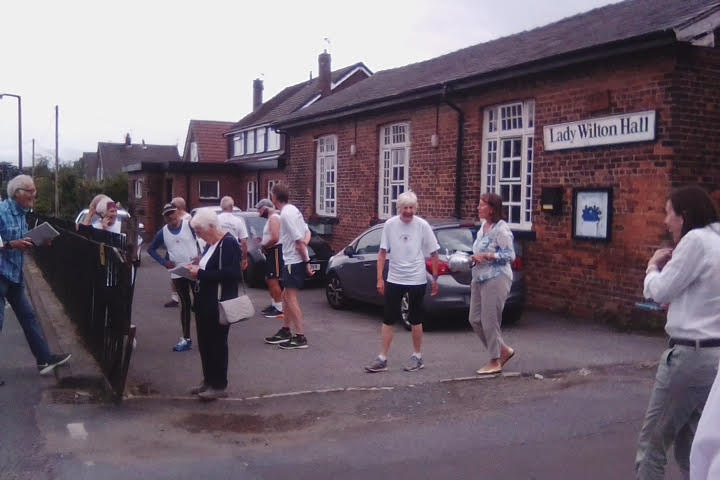
Thankfully the Fred Pearce Memorial Relay is to go ahead on Saturday, July 24 at Simister, 1.30 start. All the facilities of the Lady Wilton Hall will be available. We’re pleased and grateful to report that Christine Pearce will be providing the refreshments.

In this context [ how many butties should Chris make?!] and with Dave Evans having to sort out the relay teams it would be enormously helpful if you would let Dave or me know if you are attending and in what capacity.

dave.evans08@hotmail.co.uk

tonymtaylor@gmail.com

The Relay is a centre piece in our calendar and is a touching reminder of all that we owe to Fred Snr and Fred Jnr, together with the Pearce family as a whole.

I’m gutted not be with you on Saturday as you know how much the very name Pearce means to me. Flights were booked. I must confess that the government’s refusal to recognise my European Union digital certificate of vaccination irks, especially as I’m less than keen on increasing State surveillance of all our lives. As things stand I must go into 10 days quarantine on my return to England’s green and pleasant lands even though I’ve been innoculated twice with exactly the same experimental drug as used in the UK. This is carrying anti-European, chauvinistic sentiment to a silly end. I can but hope that a measure of good sense will prevail in the next few weeks. Flights are booked now for September!

Less of my whingeing. Here’s to a sunny day, fierce competition and a plethora of personal bests in memory of father and son.

James and Bronte hoping for better weather this year!!
Posted in News | Tagged , , | Leave a comment

On Ron Wallwork’s 80th: A Personal Reminiscence

Weeks later than promised here is my personal contribution to celebrating Ron’s 80th.

Ron, Joan and family out for a walk on his 80th birthday

My first memory of Ron sees him striding stylishly towards me, already in the lead as the 1959 Northern Junior 10 miles championship unfolds. For my part, I was positioned a few yards up a railway bridge in the village of Bickershaw, thirteen years later the infamous site of a mud-spattered pop festival. The course comprised an initial out and back section, to which I had been assigned, followed by three undulating laps of just under 3 miles. Back in the red-brick Hindley Green Labour Club, where the competitors changed in the committee room and milky tea poured out of large green metal kettles was the obligatory post-race refreshment, I was too shy a twelve-year-old to say anything. However, I could sense a buzz of excitement from the gathered besuited Lancashire Walking Club officials. Had the club unearthed someone, who might begin to challenge the dominance of Sheffield United Harriers with its array of stars, such as Roland Hardy and Lol Allen? Indeed in retrospect it certainly had.

Ron leads Jack Sankey and Mike Jeffries in a 1958 club race at Leyland
One of my appearances in a club race at Leigh , circa 1962. From left to right – Dick Smith, Joe Lambert, Mike Hatton, Graham Abley, Frank O”Neill, Fred Pearce Jnr, Fred Pearce Snr, John Grocott, Ron [the tallest at the back], Ivor Percival, a youthful me John Todd and Dick Rattigan. Tucked away on the pavement berween Dick and Joe is the diminutive figure of Zena Smith. Has anyone got a good photo of her? She was an ever present stalwart.

Over the next few years, given the absence of opportunities for youths and juniors in the North-West  I was allowed to race in club events now and again. During this period Ron was living up to the old guard’s expectations, winning Northern titles and establishing himself, in the words of Race Walking Record, ‘as a walker with a very bright future’.  Indeed, my next memory of Ron conjures up his image in pursuit of the majestic Ken Matthews in the 1963 National 10 miles championship held in Manchester at the rain-drenched Belle Vue Zoological Gardens.  He was to finish fifth behind Ken, Paul Nihill, John Edgington and Vaughan Thomas. The sight of these stars in full flight had a great impact on me. Later that year in October Ron was a member of the GB team that defended successfully its grip on the Lugano Trophy, the World Cup of Race Walking. He finished a magnificent 5th in the 50 kilometres. Could I ever hope somehow to follow in his footsteps?

A key moment in my relationship with Ron came in 1967, courtesy of the Northern Senior 10 miles championship held on the hilly roads of the picturesque village of Holloway in Derbyshire, home of the enthusiastic Northern President, Joe Twells. Travelling down from Newcastle where I was studying, playing football and beginning to train a little more consistently I found myself making history in the company of Ron, Julian Hopkins and John Todd. Below the banner ‘Wallwork puts an end to Sheffield Run’ Peter Keeling, a 4-minute miler himself and a good friend of our sport, explained in the Manchester Guardian.

Since the race was started in 1947 Sheffield United Harriers have always won the Northern 10 Miles road walking championships but on Saturday their run – the longest monopoly of any event in the British sporting calendar – was ended by the Lancashire Walking Club.

Sheffield without International Mal Tolley defended their record bitterly, even to the extent of bringing back veteran Olympic walkers Lol Allen and Paddy Proctor. But Lancashire led by Empire Games gold medalist Ron Wallwork just had the edge by a four-point margin, despite spirited packing by their Yorkshire rival.

Wallwork’s impressive individual victory, his fifth successive win in the event, left him seven hundred yards ahead of Wakefield’s Guy Goodair and George Barras.

A classic image of Sheffield’s post-war dominance – all those hooped shirts! Lol Allen is taking the lead on the inside. Other notables are John Dowling [32], Norman Hopkinson [41] and Mick Greasley [28]. John Todd to Mick’s right is the first Lancs competitor.

In the pub afterwards, sharing a shandy with Ron [nothing ever stronger as I remember], I felt the flowering of a friendship. Although he was a gold medalist and on his way to winning both the national 10 miles and 20 km championships that year he was without ego, possessed of an engaging smile and a wry sense of humour. In particular, he was an attentive listener, a quality to be treasured and, in my experience, rarer than a truthful answer from Boris Johnson.

Ron triumphs in the 1967 National 10

In hindsight 1968 was a frustrating year for Ron himself as he missed out on making the Olympic team. Yet in a contradictory way, this setback was to be the stimulus for both his own spectacular comeback in the next few years and the rise to consistent national prominence of the Lancashire Walking Club itself. Such was the enthusiasm Ron generated that I moved with my first wife, Hilary into a one-up, one-down cottage complete with a lavatory across the cobbled street, that led to the Eagley Mills in Bolton – a couple of miles from Ron’s and twelve from the school where I taught. The priorities were plain – training first, teaching second, toilet facilities a constipating third! To illustrate what you might well see as my skewed priorities, I arose in the said cottage on the Sunday after my wedding the previous day to participate in a training event, organised at Leverhulme Park by Ron. Such was my romantic honeymoon.

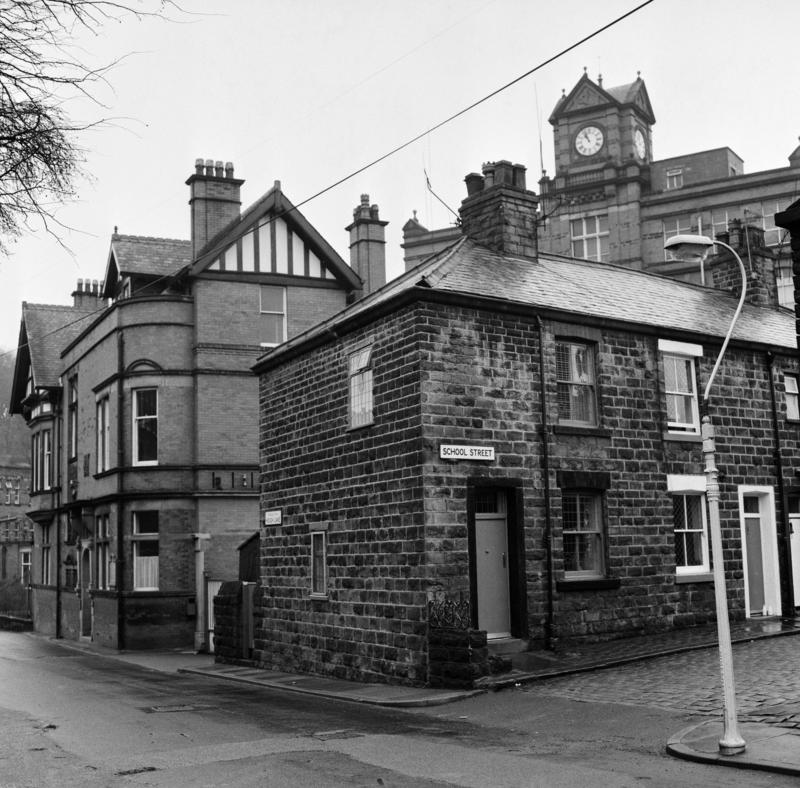
School Street, Eagley Mills where a strong bladder was required!

Over the next few years, Ron burst back onto the national and international scene. I can but mention a few of the things we did together that both played a part in his revival and illustrate his commitment and desire to do the best for the club and the sport.

In a gesture to the Mexico Olympics, we formed in October 1968 the ‘Groupo Uno’. Apart from Ron and I, regulars were Steve Crow, second to the mercurial Olly Cavigioli in the National Youth 3 miles of that year, Mick Entwistle, team player extraordinaire, Dave Vickers, a converted steeplechaser, who in a meteoric rise to prominence had just won the classic Dick Hudson’s race and, last but not least, Julian Hopkins, who was to become an innovative and controversial National coach. Amongst our sessions was the Wayo Assault Course, named after the beautiful reservoir where the masochism took place in the early hours of Sunday mornings. Always it seemed in the pouring rain. The exercise consisted of a combination of strolling and running around the reservoir itself,  all of which was a prelude to a series of exercises undertaken on a steep slope above the tranquil waters below. Passing ramblers were perplexed to see us hopping on two legs, on one leg, forwards and backwards, up and down dale. Years later you could still see the down-trodden area we had ploughed up with our gymnastic antics.

Wayo on an unusually sunny day!

Winter evenings saw us introducing on Mondays and Fridays a programme of demanding circuit training. along with an increased emphasis on mobility exercises. We tried to convince one another that racing was bound to be easier than this twenty minutes of hell.  Thanks to Ron’s relationship with the caretaker of his old secondary school we used unofficially its gym and its equipment. carefully putting everything back in place before locking up after ourselves. Such an informal and trusting agreement would be utterly impossible nowadays.

A fast session every week was essential, usually midweek from Ron’s house or at the weekend from the Leverhulme Park track, home of the Bolton United Harriers and the likes of Ron Hill, Mike Freary and Steve Kenyon. Most of these efforts were not timed. Neither were the courses measured. Everything was down to how we felt. How far is such an intuitive approach from the exhaustive data-driven regimes of today? This said,  our resident physicist Julian Hopkins was beginning to drag us from the subjective to the objective, drawing on his meticulous scientific mind. As it was, ignoring Julian’s insights, every month our unashamed ‘blast’ preceded a nourishing meal prepared by Joan, which set us up for the dash to the splendour of the Midland Hotel, West Didsbury for the always well-attended club committee meetings. 

The Midland Hotel, West Didsbury with the LWC club crest on the wall

Together with Chris Bolton and Fred Pearce, Ron was instrumental in producing CONTACT, the club’s monthly newsletter, which was an essential ingredient in nourishing our camaraderie and respect for each other. One way or another every member of the club was afforded a well-earned mention in its pages.

To give you an idea of the dedication demanded by Ron we went on holiday together in early July 1969 to Criccieth, a beautiful resort in North Wales.  Our relaxing break went as follows.

Saturday – arrived after an eventful journey in Ron’s ageing car. Settled in and at 9.00 pm 7k run, partly on the beach.

Sunday – 8.15 am 15k steady walking; 2.00 pm 2k running on sand dunes; 9.00 pm 7k run

Monday – 7.10 am 40k comprising stroll from Criccieth to Snowdon followed by ascent and descent of the mountain via the Watkin and Pyg tracks. Ignored the effort of a Countryside Warden to dissuade us from proceeding on account of our scanty attire.  Met by Joan, two years old, Linda, born on the eve of Ron’s 1967 National Ten victory and my first wife Hilary in the support vehicle.

Tuesday – 8.30 am 12k fastish walking; 5.45 pm 12k run on a mix of road and sand.

Wednesday -7.45 am 15k steady walking; 6.00 pm 8k run through fields. Heated conversation with nettles!

Thursday – 9.00 am 12.5k run; 7.40 pm 12.5k fast walking reverse direction.

Friday – 8.50 am 12.5k easy walking; 8.00 pm 8.5k run roads and tracks

Saturday – 8.00 am 10k run, Black Rock Sands. Travelled home – a little tired.

Total: 173k – Enough said. What Joan, Hilary and Linda thought about this week’s frolics and fun is another matter!?

Responding to Dave Ainsworth’s lovely tribute to him in the Essex Walker, Ron recalled what he thought of as one of his greatest weekends, May 30/31, 1971.

On the 30th, I drove from Bolton to Saffron Lane, Leicester for the CAU 10km championships finishing second in 43.57 to the great Phil Embleton, 42.24, then drove home. On the following day I drove from Bolton to Bradford for a 9.30 start and after a torrid battle with John Warhurst won in 4.29.20, one of the few sub 4.30 performances at that time. John clocked 4.30.03. Oh, and then I drove home again and turned in for work at 07.30 the following day.

Ron and Jake Warhurst shoulder to shoulder

Yet Ron’s Inter-Counties 10km and  Bradford 50km double tells only part of the tale, within which I played a supporting role. On the Bank Holiday Monday as he was battling with John I was his Lancashire County substitute in a lively CAU 3 km, finishing a distant fourth behind Bob Hughes, Geoff Toone and Wilf Wesch. The fancied favourite Phil Embleton was disqualified by none other than Bob’s dad, Alf! The decision was accepted with good grace.  However, the week was far from over. In Blackpool the following weekend for the Lancashire 3km and Northern 10km championships, Ron was victorious in both events with me chasing forlornly as usual, followed by the evergreen Joe Barraclough in the shorter and  Sheffield’s John Warhurst in the longer distance. Not a bad eight day’s racing for Ron!! Certainly, he was in great shape that summer as confirmed by his 2 hours UK record in late July. With hindsight, it is tempting to suggest that in 1971 Ron would have been better served by focusing on the 20 rather than 50 kilometres, being selected for the European Games in the latter, where he was forced to retire. Personally, I’m sure that in the right race he would have gone under 90 minutes for 20 kilometres.

As can be seen from above my very best memories of Ron might well be found in the many miles we did together in training. Although I must confess to being envious, even jealous of the fact that Ron never seemed injured. Or perhaps he never complained when he was. As for myself, I was more than prone to whingeing ad nauseam about my painful right groin and hamstring! In passing let me mention that Ron never ventured out to train on Guy Fawkes Day. In those days every street seemed to host a bonfire. Over in the world of serious competition, he always found another gear, leaving me trailing in his wake. I remember with joy finishing 6th [74:07] in the 1970 National 10 at Kirkby, close behind Phil Embleton, as Ron was pipped by Wilf Wesch for the title. Mistakenly I felt I was on my way to greater things, inspired by Ron. It was not to be. I never really lived up to that promise.

The 1970 Metropolitan 20 kilometres. As ever I’m following Ron with Wilf Wesch [124] to our left

Nevertheless, in 1971 I was chuffed to be with him in the 20 kilometres winning team, the club’s very first national title; made up to be on the same sodden Blackburn track when he broke Ken Matthews’ 2 hour track record; and proud to be selected alongside him to represent GB in the match against West Germany – a first for the club, having two members in the same international team. As for our personal rivalry it’s revealing to note Colin Young’s reaction in the Athletics Weekly to my defence iin 1974 of the Lancashire 15 kilometres title. Somewhat shocked Colin penned a headline, startling in its simplicity, ‘Tony Taylor beats Ron Wallwork’, omitting sensitively the caveat ‘at last’! The spectators at the race itself in Stockport were equally stunned.

The eagle-eyed will notice that both of us raced in the colours of Blackburn Harriers. There is a tale that needs telling as to how this came about.

1974 was to prove a pivotal and contrary year for both Ron and me. At least I think so. On paper 1974 was my best year in the sport, ranked 6th at 20 kilometres, selected for my second GB vest. Yet something was not quite right. My discovery of Marxism and political activism clashed increasingly with my athletic pretensions. In the ensuing years, I was to spend more time on the picket line than the starting line. As for Ron, performances on the road were disappointing by his high standards and a new career with fresh challenges beckoned.

On the picket line in 1979. Bearded as befits a would-be revolutionary!

By a twist of fate, the way forward for both of us was to be provided by youth work, the oft-misunderstood world of relationships and conversations with young people outside of schools and further education. Out of the blue, or so it seemed, Ron had been offered the post of full-time trainee youth worker with the Lancashire County Council. Within weeks I was doing part-time evenings, sweating profusely in the gym of the Briarcroft Youth Centre for which he was responsible. To cut the story short, Ron moved to Leicester in pursuit of his full-time qualification, whilst I leapt from teaching into youth work with the newly created Metropolitan Borough of Wigan. For an insight into Ron’s philosophy as a youth worker and human being see this link – his humanity shines through.

Ron was that rare character, who worked with young people and the community on the same patch throughout his professional career. Huge respect.

Our paths were not to cross for many a year, catching up with one another made even more difficult by my emigration to Crete. As is well-known Ron has continued to make a remarkable contribution to race walking in general – even now the leading light in the success of the Enfield Walking League. For my part, I am grateful and privileged to have been his friend and training partner those decades ago. And, I know it seems a tired cliche but when we have met up in recent years, notably when we celebrated the anniversary of his UK record, in my mind I can still see us going hell for leather up Crompton Way, ‘eyeballs out’ on a bitterly cold Bolton evening back in 1969. It’s as if it was only yesterday. Thanks for the treasured memories, Ron and enormous respect. for all you have achieved.

Posted in History | Tagged , , , | 1 Comment

THE MONTH OF JUNE: LWC 3 KM TIME TRIAL

There’s been a good response to our June 3 kilometres time trial. Hence it looks as if the notion is proving useful and motivating. Thanks are due too for the accompanying messages, which add spice and interest in maintaining our contact with one another.

Another blast from the past shows from the right, Ken Matthews, Stan Vickers and Eric Hall in either the 1959 or 1960 National 10 miles. In both races they finished in that order.. Ken clocked 70:57 in 1960 when Ron Wallwork raced his first National 10 finishing 20th,

Ian Hilditch – Tony, the temperature this morning was only 21 degrees so only half of what you have been experiencing.

Marco Bernatzki – under hot and sweltering conditions. Greetings from Germany.

Greg Smith – Walked on a 760 metres circuit on an industrial estate that used to be knownas the Bury ground. It was done on a warm summer’s day on one of the few bits of flat land in these parts. Please note my time of 18:34 (an improvement on last month). Am now recovering from hernia surgery. Hope to get along to the Fred Pearce relays on 24th July to watch/marshall/photograph.

Martin Payne – Tony, you talked me into it! [Martin had indicated he might not do a 3k as he was focusing on longer distances. I begged him to think again.]


Glyn Jones – After my disappointing performance at the Bury track 10km, things went a bit downhill during the earlier and mid part of June. Whether it was the heat at Bury or some other cause I am not sure, but I came down with a very heavy head cold, a cough and a runny nose and  wobbly on the legs. All in all it felt like flu, but of course I regularly have the flu injection and also I have had both vaccinations. Anyway I just felt like a damp squib and on the advice of my daughter went to the local Covid test centre and which I am pleased to say came back ‘negative’ and the same for a lateral home test some days later which I needed as I was officiating at the British Championships in Manchester last weekend. (27th.June) My co-walks officials said I looked tired but I didn’t want to let the side down and make them short.

Consequently race walk training was non existence until this week when feeling much better and stronger I was putting my Addidas shoes back on and went out along the lanes to get back into the mode of training again. I have only been out twice, the second time today (Thursday) and did the June virtual 3km. My time was 20mins 35secs for 3km which in the circumstances I was happy with.It was late afternoon, quite sunny, warm with no breeze at all and no traffic whatsoever along the lanes.When I am back next week, will start to get some longer walks to get ready for the Fred Pearce Relays at Simister when I hope to be there.

John Crahan – Cavendish emulates Crahan. Bob Monkhouse once said “They laughed when I said I was going to be a comedian -they are not laughing now”.On a day when my coach had to race behind closed doors at her school sports I did a 3k in 20 mins 33 sec.I am really tired after training fairly hard but 3k has always been my best /least worse distance.My walk finished at the War Memorial -amongst the many names is the man I am humbled to be to named after. I hope that my change from Stella to Peroni aids my return to a less sloth like progression.

Tony Taylor – A real struggle, not just on account of the furnace-like heat. I was chatting to Greg a few months ago about continuing back and hip problems, saying it might be a good idea to have a few months just rambling around our country lanes. However I kept going, mainly because of the Virtual Series. I could cope with just 2 kilometres! As it stands the hip is really sore so a rest of sorts is on the cards. Hoping to be back for the Lambert Trophy.

Posted in News, Results | Tagged , , , | Leave a comment